Tag Archives: dip pen and ink

Mini Masterpieces

Rachel — collage on vintage book board available to buy until 28 Nov 2025

Hello gentle readers. It’s been a while. I’ve just finished a book project, (more on that later) and I’m at the clearing up stage. Putting things to rights in the studio, starting to clear up the house, dipping my toe joyfully into the waters of recreational sewing.

I thought I’d reach out to make sure you’re aware of the IBBY fundraising auction that finishes tomorrow. You can browse all of the items for sale, here. They have been donated by Australian illustrators including me. If you’d like to contribute to this worthy cause, you will need to register to bid, (which is easy), and then go for it! Bidding closes tomorrow 28 November, at 9:00pm AEDT so you don’t have much time.

At the bottom of this post I’ve pasted in a little bit of information about IBBY, so that you can understand why IBBY might be on my radar. They’re all about young people, books for young people and supporting the creators of those books as well. But first, here’s a little background story about these rather unusual artworks.

Anyone who has been following this blog since the very beginning will know that when I started it, I was discovering the joys of altered book art. I was visiting used book fairs, collecting old books, some to read and some to cut up or draw in. After a few years, it seemed to me that altered book art was everywhere; everyone was doing it, and so it interested me less. The simple fact of a drawing being on a book page was not in itself interesting to me any more, although it had been a wonderful breakthrough for me when I was trying to find a medium, style and colour palette for Thunderstorm Dancing. (If you’re curious, go here.)

I still loved the subtle ways in which a drawing could respond to the text on the page, reinterpreting a few words, or taking an ironic look at the subject matter. And found poetry was and still is a delight to me. But I let it recede as my work went in different directions.

Later, I found myself irresistibly attracted to the cloth-covered book boards from vintage hardbound books. I began using them as substrates for drawings and paintings.

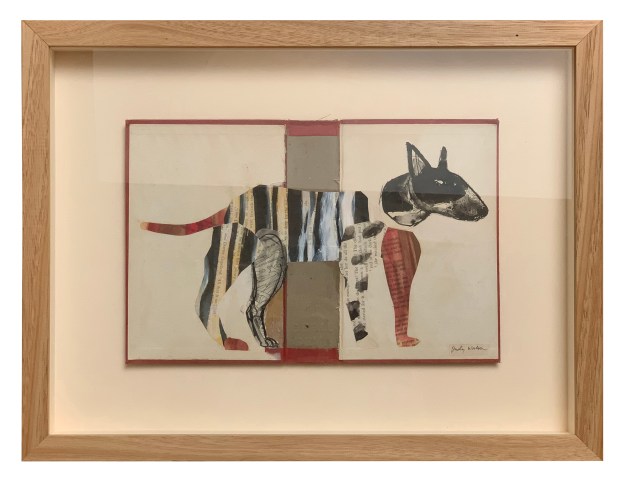
Collage has always been an important element in my work, both the paper and scissors kind, and the digital variety. In 2023, IBBY asked me to contribute a mini artwork for their Mini Masterpieces fundraiser and book boards were more or less the right scale. Some playful collages emerged. Below you see Mike, Maxine, Jennifer and Alan. They became my first Party Animals — characters who seemed so alive to me that they virtually wrote their own stories. If you’d like to read their accompanying microfiction stories I now have my Party Animals collected together on their own Instagram page https://www.instagram.com/judywatsoncollage/ and I’ll also add a page for them on this site in the coming weeks. As I make new Party Animals from time to time, they’ll be made available for sale there.

But now to the 2025 IBBY Party Animals!

Rachel and Trent

Trent — collage on vintage book board available to buy until 28 Nov 2025
Rachel — collage on vintage book board available to buy until 28 Nov 2025

These two followed their own stars. They look a little different from the 2023 partiers, but this time, they have been wrapped for travel with their own stories enclosed, so that you will know a little bit about them. I recently purchased a 1970s vintage typewriter, and I’ve been writing poetry on it, but I felt I wasn’t quite up to the challenge of typing their stories to the correct size and without a plethora of errors. Instead, I carefully chose a suitable typeface and printed their stories on good paper.

I also contributed three quick dip pen and ink sketches for the fundraiser. They’re based on reference photos of dogs and their owners that I took at a local pet day. You’ll see them here too. Below is the promised information about IBBY. If you’d like to support a wonderful organisation that supports children and the children’s literature community and if you’d like to purchase an original work of art from one of Australia’s book illustrators, then you can’t go wrong throwing in a bid for one of these artworks. Even if you don’t win the auction, you will bump up the price and help IBBY in the process. Good luck!

About IBBY Australia

IBBY Australia is one of 85 National sections of the International Board on Books for Young People (IBBY), and will be turning 60 in 2026.
IBBY is a non-profit organization which helps to build bridges to international understanding through children’s books. 
IBBY Australia submits authors and illustrators and their work for several IBBY administered international awards, including:
• the Hans Christian Andersen Award
• IBBY Honour Book List
• the Silent Books collection and
• the Outstanding Books for Young People with Disabilities list. 
You can read more about IBBY on this web site: https://www.ibby.org, and about IBBY Australia here: 
https://ibbyaustralia.wordpress.com
or join online here:
https://ibbyaustralia.wordpress.com/join-us/ – we welcome new members!

The Kick-About #125 ‘the Rorschach Test’ (part 3)

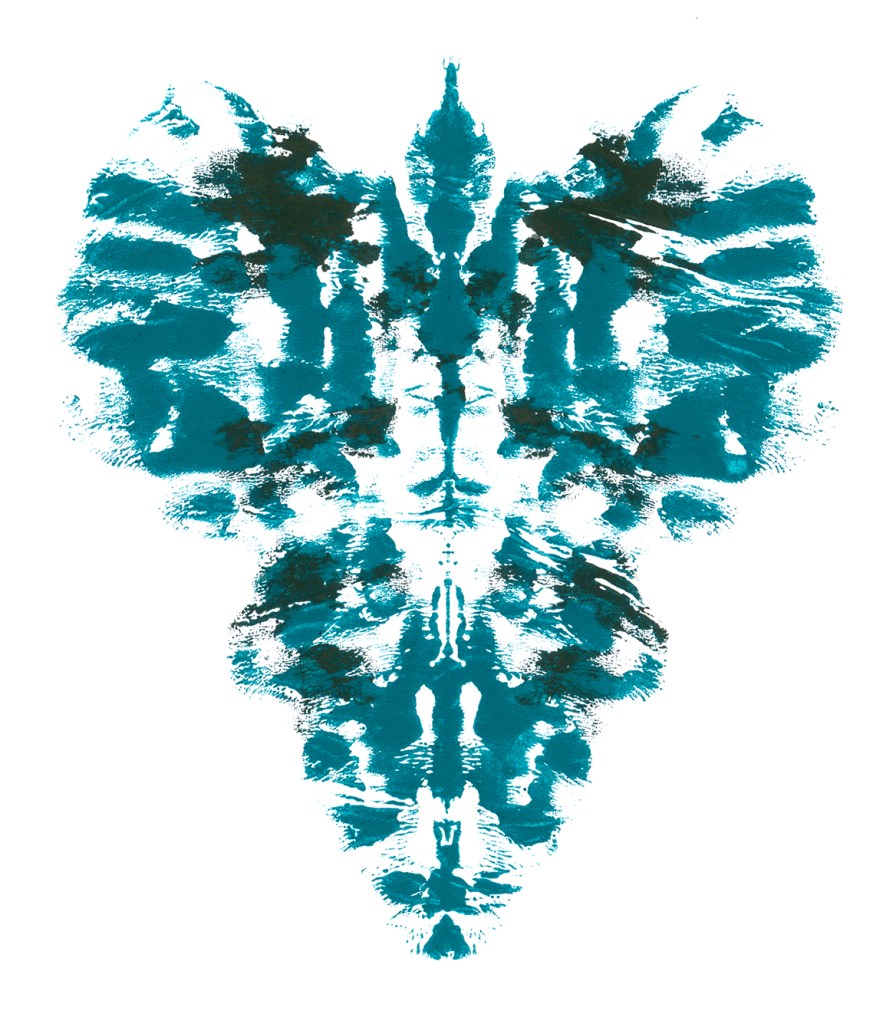
Hello again. Here is my last (I think) post in response to the Rorschach Test prompt from the Kick-About challenge hosted by Phil Gomm. This is my fully analogue response.

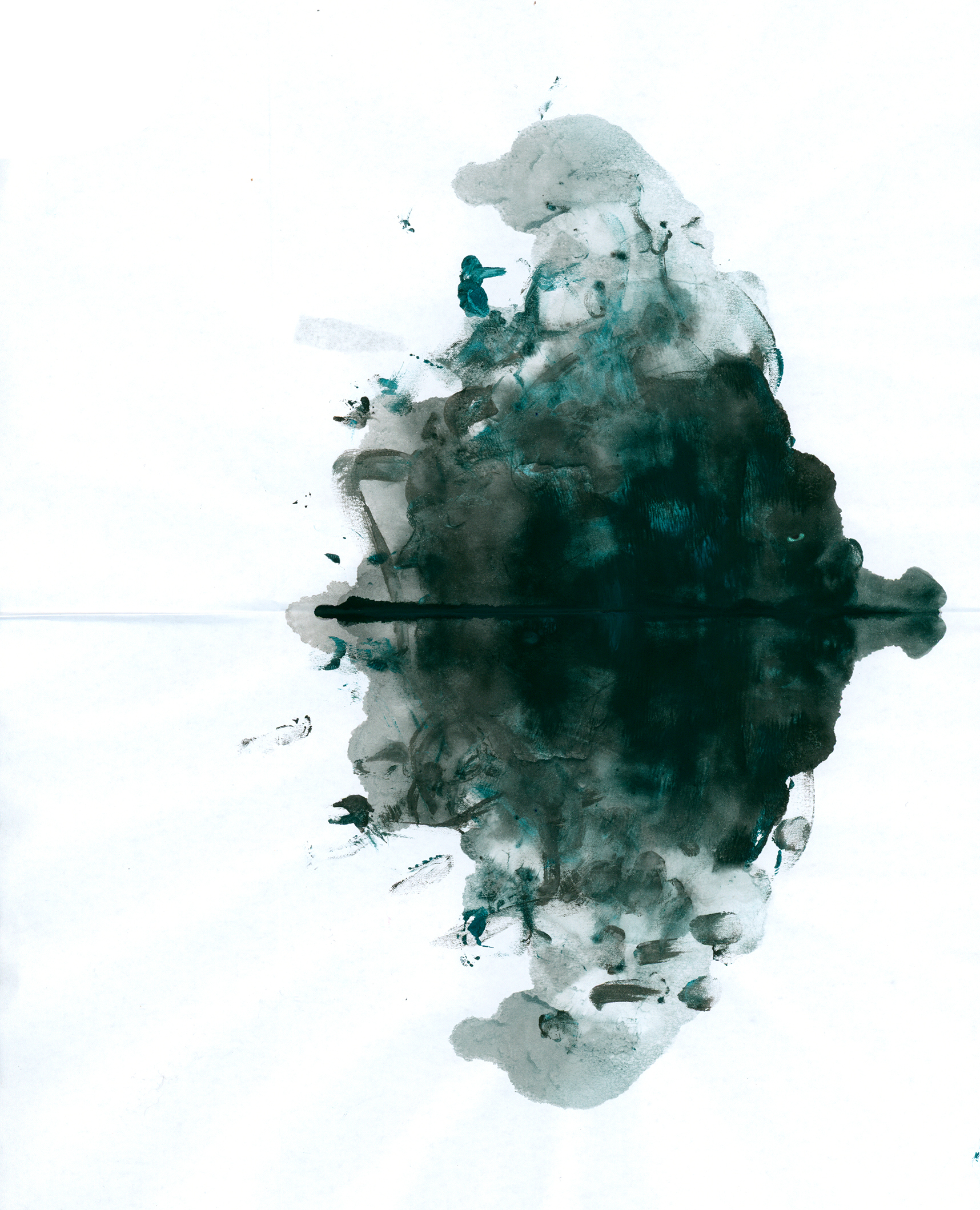
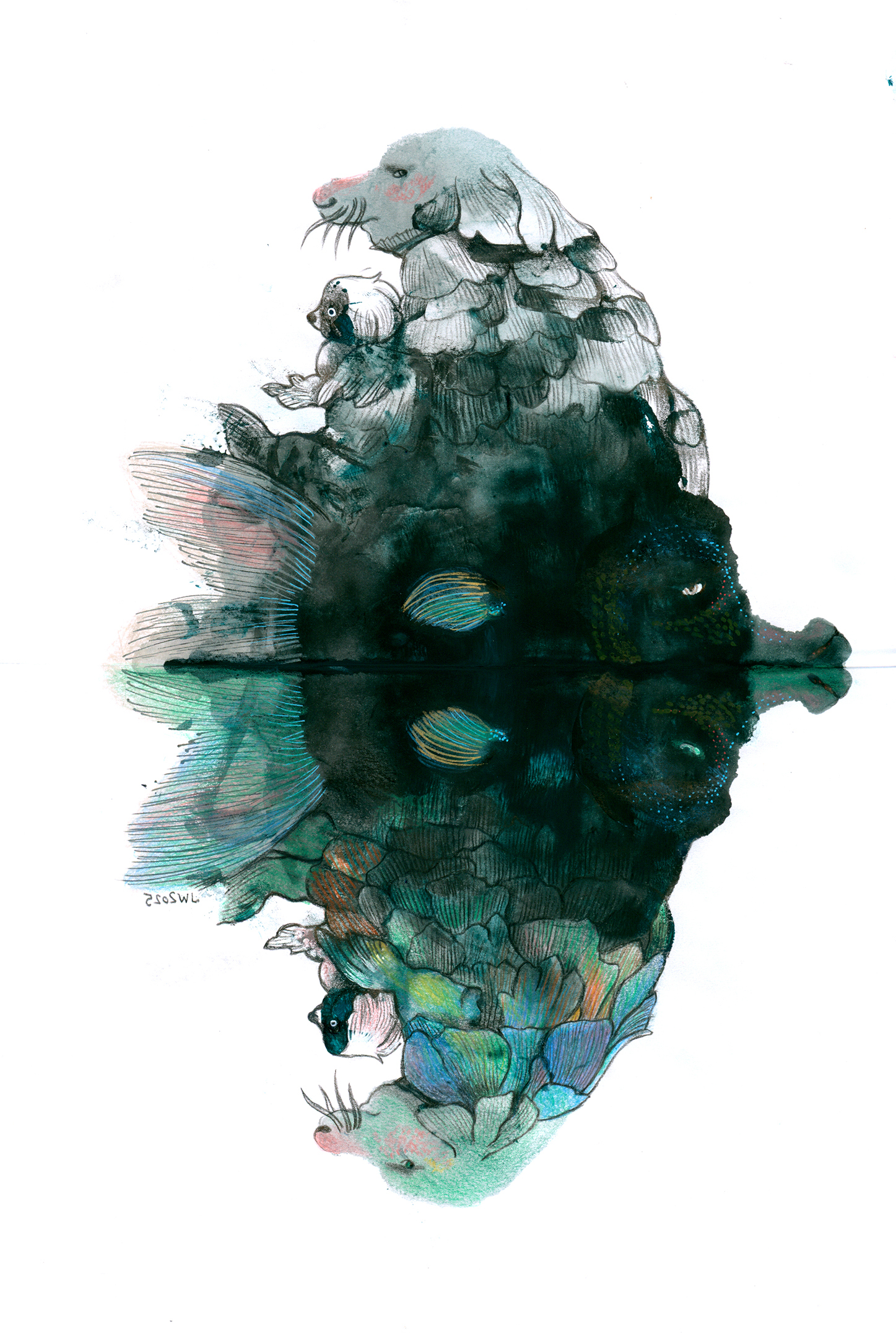
This inkblot looks EXACTLY like a lugubrious Long-nosed WhaleFish swimming across the surface of a lake carrying a weird, slightly menacing figure with a smaller figure on its lap.

It looks like that to you too, right?

So I tackled this one with Polychromos pencils and Posca pens. I really wanted it to be travelling left to right (English language picture book illustration is now in my bones), but when I was most of the way through, it looked better up the other way, mainly because of the colour in the water reflection.

I’ve refrained from ‘cleaning up’ the image in PhotoShop in order to remain true to its hand-made inkblottiness. All I did was dot a bit of white Posca pen to some of the more intrusively messy marks. So here it is.

Dogfish with Piebald Child riding a Long-nosed WhaleFish who is Really a Prince Under an Enchantment. If you want to rescue the prince, you’ll probably have to climb a mountain, wearing slippers made of prickly pears, and retrieve a plum from a magic tree that only fruits once every 50 years. Then come back and feed it to the fish… or something. I wish you luck. There’s no guarantee that he’ll be a nice prince when he is human again, so you’d better be on your toes, if you haven’t lost them to frostbite.

Below I’ve flipped the image so that you can compare it with the original ink blot.

The Kick-About #125 ‘the Rorschach Test’ (part 2)

Hello again. I’m not finished with ink blots for the Kick-About. And I‘m not finished with islands reflected in still water.

It’s not the first time I’ve gone down this road. I remember printing dozens and dozens of icebergs and islands for When You’re Older. In some illustrations I was conflicted because I liked the reflections on the water surface, but I was also enchanted by the creatures underneath the surface.

Question: How to have both in the one illustration?
Answer: Not easily.

But back to the current time! Yes, I did produce something new for this Kick-About prompt. The theme makes me think of (self) reflection, and it seems the world is full of people who see themselves in different ways.

Some don’t like what they see.
Some delight in it.
Some refuse to look at themselves at all.
Some see a version of themself that is invisible to others.
And the opposite is also true.

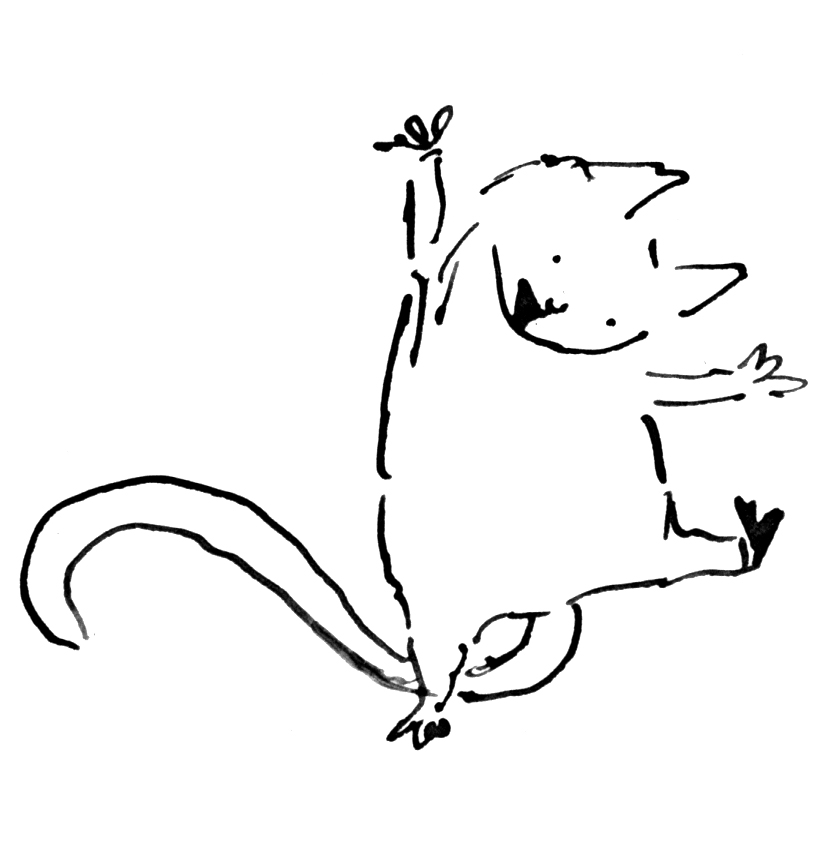
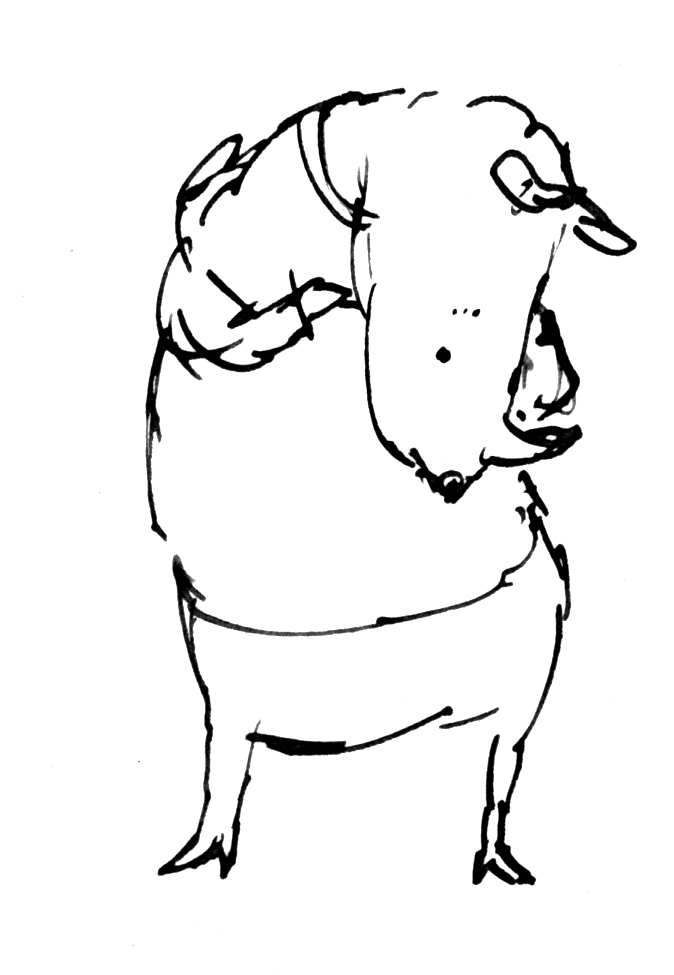
I sketched 12 small characters with dip pen and ink, to place into a scene of self reflection. Here are a few of them. (below)

Then I printed a few ink blots. A couple really do look like very interesting moths, (I’m not sure what that means about my personality type) and they are begging to be used as collage materials for something else. But they don’t suggest islands to me, so I used the more solid results.

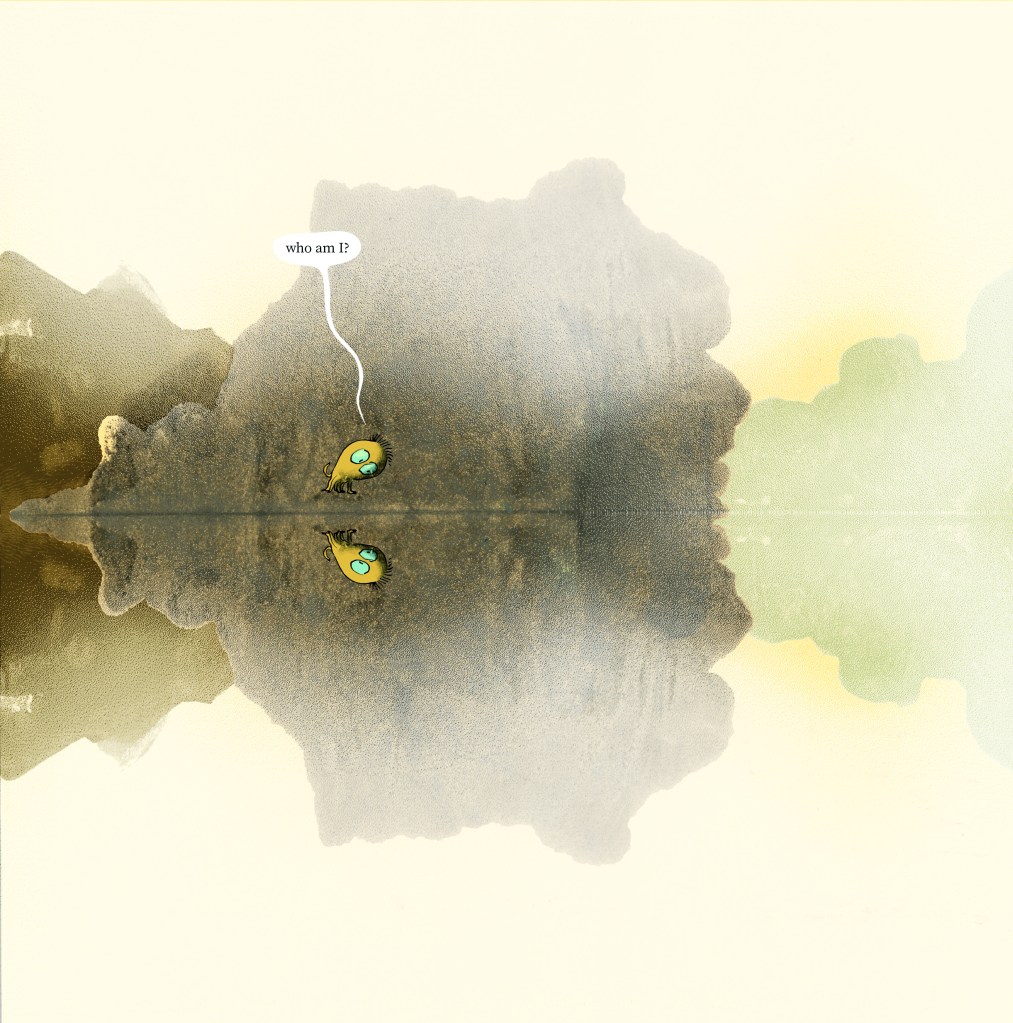
This ink blot on yellow paper is so evocative of a rocky island, that it didn’t need my interference at all. And the yellow just added to the atmosphere. But I wanted to use at least one of my characters, so I added some mist, and background islands, and then put my character in.

I was quite pleased with the result, and I feel for this little creature having an identity crisis, all alone. Although the text is at a scale that would work best on a full page illustration, and is probably illegible at this size.

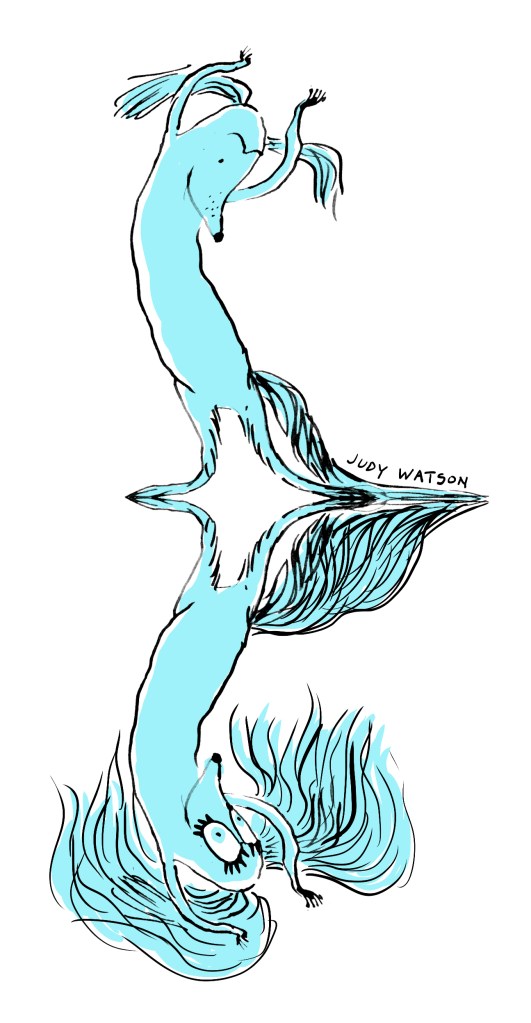
And then I played with a second character with no background at all. I think this funny little creature is a cousin of the legendary Narcissus, but if you flip the image upside down, you have the more universal experience of looking in a mirror.

Hazel’s Treehouse – floriferous!

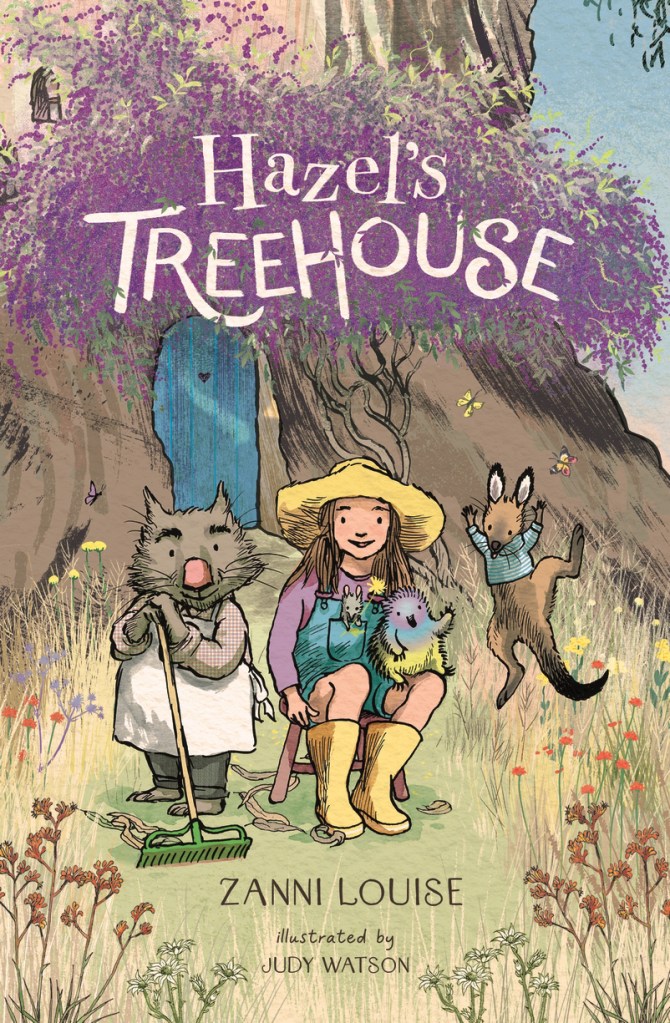
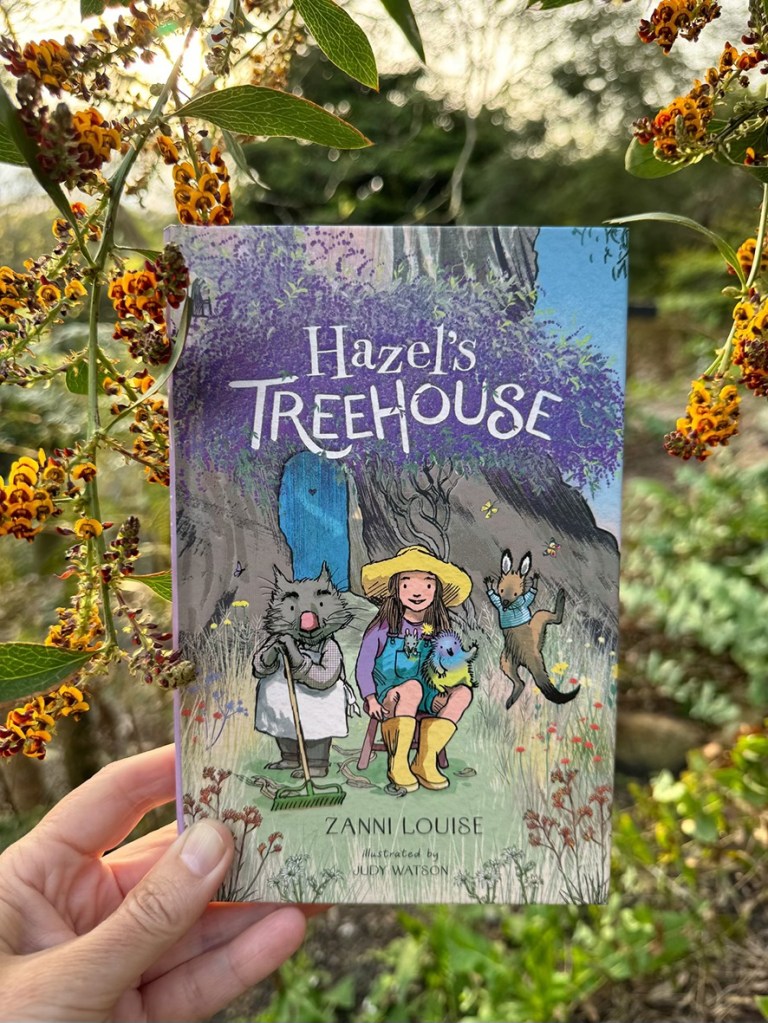
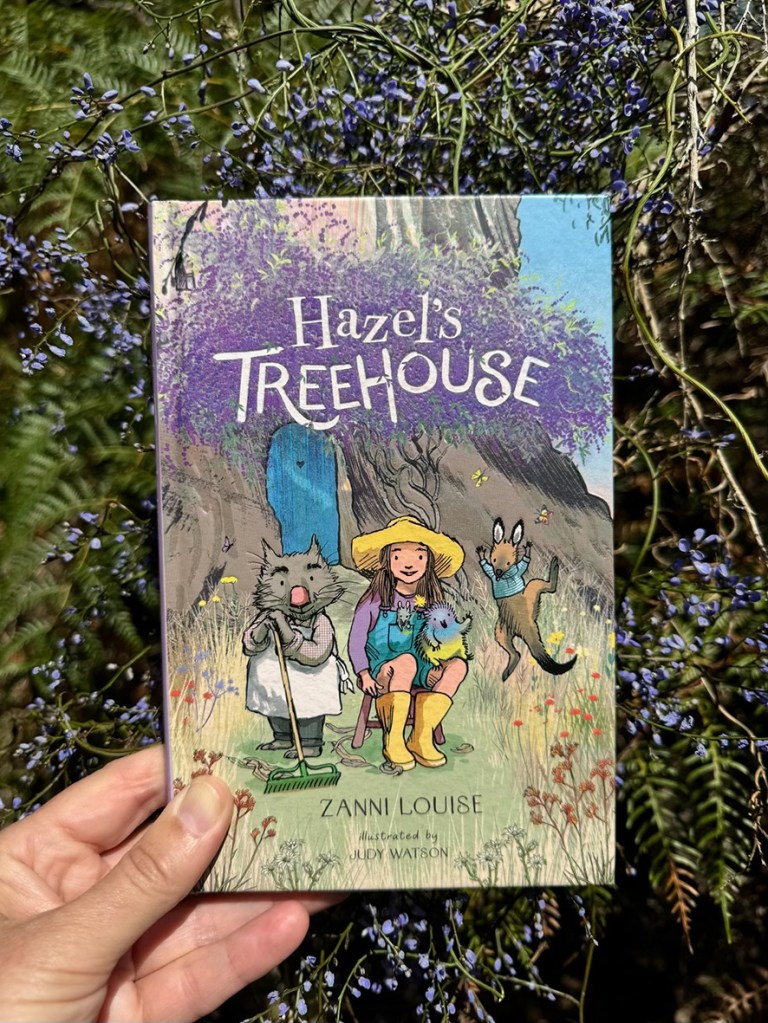
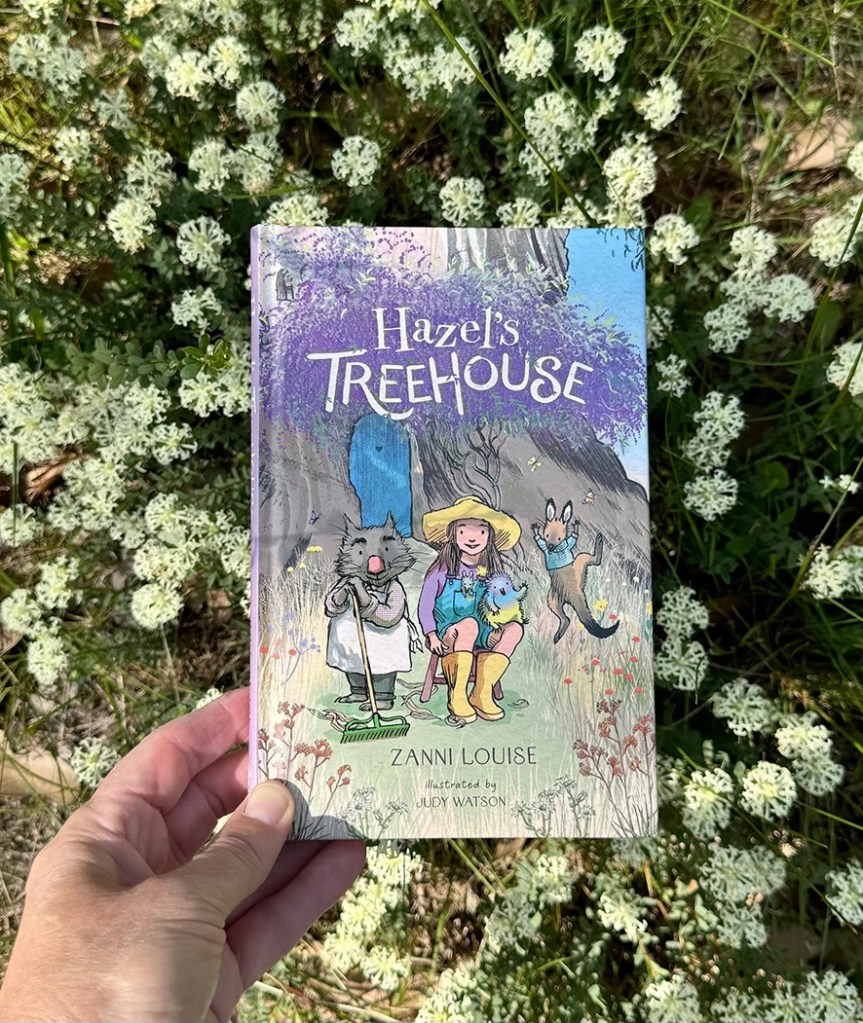
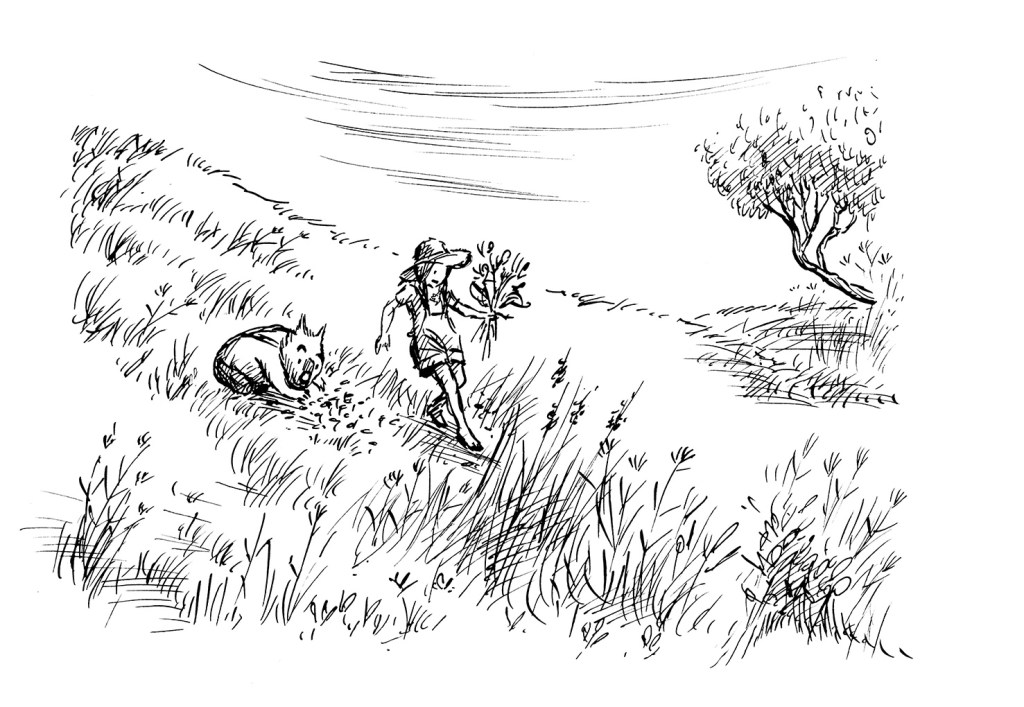
Hazel’s Treehouse is a new collection of gentle junior fiction stories from Walker Books Australia. It’s written by Zanni Louise, illustrated by me in dip pen and ink and it’s wrapped in flowers from its embossed hard cover and purple endpapers, through each of the ten stories to the creator biographies at the end.

Zanni’s a talented and prolific author across all age groups from the very young to YA, and she’s also an adept teacher. So I was delighted to be offered her stories to illustrate. You can check out her other books here if you haven’t already come across them.

Everyone except Odette is cloud gazing. Odette is bouncy so she’s rolling down a hill somewhere.

The book came out at the start of November amid an exuberance of spring flowers in our garden and local surrounds, because we’re lucky enough to live opposite a creek reserve and just down the road from a retired reservoir set in native bushland. I loved taking my advance copies of the book out for walks in the bush and photographing it against whatever was in bloom. There’s a floral sampling below, including some of the show-offs and some of the delicate species that people may overlook. In much of Australia, harsh weather, shallow topsoil and unreliable rainfall have combined to evolve plants that conserve energy with small blooms and avoid dehydration with sparse leaves. These plants are quietly beautiful and tough.

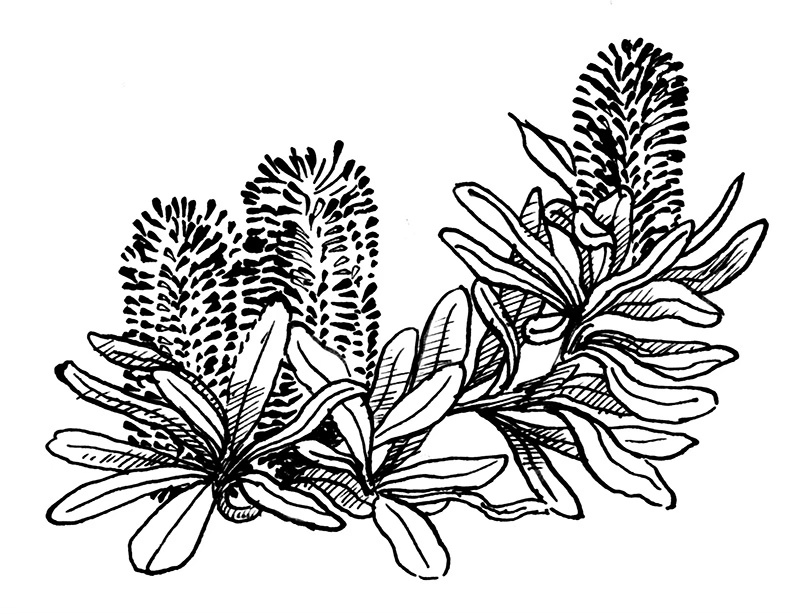
Zanni referred to several Australian flower species in her text, and because I had worked in nature conservation and had a horticultural husband brimming with indigenous plant nerdiness, it was an easy thing to embrace those references and run with them. I chose a plant to begin each story – whichever seemed the best fit (and that I felt capable of drawing!) Some of them were mentioned in the text and some were appropriate for other reasons. Christmas Orchids (Calanthe triplicata) adorned the Christmas story ‘A Very Tiny Day’. Coast Banksia (Banksia integrifolia) was used for ‘A Beach Day’ – even though the gang never made it to the beach. (You’ll have to read it to find out what they did instead, but they still managed to use their goggles and flippers.) Sometimes, if there was no obvious link, it was an opportunity for me to feature some of my personal favourites, like Hibbertia or Pimelea.

Christmas Orchids (Calanthe triplicata) for the Christmas story ‘A Very Tiny Day’
Walter demonstrates the correct method for cooking Christmas pudding. (Flour instead of flower here.)
Coast Banksia (Banksia integrifolia) for ’A Beach Day’
Tiny demonstrates the correct fit for goggles in ‘A Beach Day’. (Shown with some wet looking Wallaby Grass)

When I first noticed the plant references in the text, I was looking for clues to the location. The setting for any story is also a major ‘character’ in the story, creating an atmosphere, a flavour, and the physical framework into which our reader can immerse themself. So it’s one of the first things that I’m feeling for when I’m reading a manuscript for the first time. I thought that Zanni might have chosen plants local to a particular area where she’d prefer to see her stories illustrated. But the plants she mentioned are found all over Australia, and in some cases nowhere near each other. This told me that my setting was an imaginary location in a magical Australia, so… no rules! But for the most part, I’ve illustrated this imaginary place as a Grassy Woodland.

The NSW Office of Environment and Heritage describes Hazel’s surroundings to a tee: The Grassy Woodlands are a widespread and quintessential feature of rural Australia. Dominated by eucalypts, typically boxes and red gums, grassy woodlands have a relatively open canopy with sparsely distributed shrubs and a conspicuous and diverse ground cover of tussock grasses and herbs. Ephemeral grasses and herbs appear from seed banks following rain, while ground orchids and lilies emerge after fires to produce a spectacular floral display. 

Walter, Hazel and Tiny (very small!) collect flowers in ‘Someone’s Special Day’

Hazel’s Treehouse has already been met with a flowering of warmth and enthusiasm from readers and reviewers. There’s much more to share about the process of illustrating it, but it seemed right to mention the flowers before the close of the last day of spring!

Oh, and here’s 54 seconds of baby Eastern Rosellas in the nest box in our garden, looking exactly like muppets.