
Subscribe to continue reading
Subscribe to get access to the rest of this post and other subscriber-only content.
Subscribe to get access to the rest of this post and other subscriber-only content.
There are only a few hours left to bid on original Australian artworks in the IBBY fundraising auction

Hello gentle readers. It’s been a while. I’ve just finished a book project, (more on that later) and I’m at the clearing up stage. Putting things to rights in the studio, starting to clear up the house, dipping my toe joyfully into the waters of recreational sewing.
I thought I’d reach out to make sure you’re aware of the IBBY fundraising auction that finishes tomorrow. You can browse all of the items for sale, here. They have been donated by Australian illustrators including me. If you’d like to contribute to this worthy cause, you will need to register to bid, (which is easy), and then go for it! Bidding closes tomorrow 28 November, at 9:00pm AEDT so you don’t have much time.
At the bottom of this post I’ve pasted in a little bit of information about IBBY, so that you can understand why IBBY might be on my radar. They’re all about young people, books for young people and supporting the creators of those books as well. But first, here’s a little background story about these rather unusual artworks.
Anyone who has been following this blog since the very beginning will know that when I started it, I was discovering the joys of altered book art. I was visiting used book fairs, collecting old books, some to read and some to cut up or draw in. After a few years, it seemed to me that altered book art was everywhere; everyone was doing it, and so it interested me less. The simple fact of a drawing being on a book page was not in itself interesting to me any more, although it had been a wonderful breakthrough for me when I was trying to find a medium, style and colour palette for Thunderstorm Dancing. (If you’re curious, go here.)

I still loved the subtle ways in which a drawing could respond to the text on the page, reinterpreting a few words, or taking an ironic look at the subject matter. And found poetry was and still is a delight to me. But I let it recede as my work went in different directions.

Later, I found myself irresistibly attracted to the cloth-covered book boards from vintage hardbound books. I began using them as substrates for drawings and paintings.

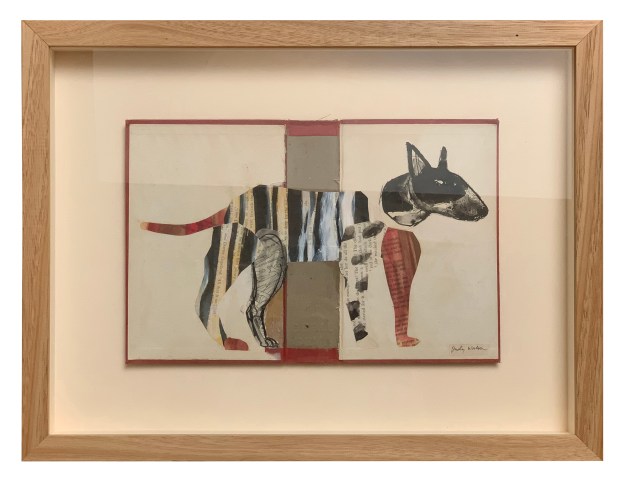
Collage has always been an important element in my work, both the paper and scissors kind, and the digital variety. In 2023, IBBY asked me to contribute a mini artwork for their Mini Masterpieces fundraiser and book boards were more or less the right scale. Some playful collages emerged. Below you see Mike, Maxine, Jennifer and Alan. They became my first Party Animals — characters who seemed so alive to me that they virtually wrote their own stories. If you’d like to read their accompanying microfiction stories I now have my Party Animals collected together on their own Instagram page https://www.instagram.com/judywatsoncollage/ and I’ll also add a page for them on this site in the coming weeks. As I make new Party Animals from time to time, they’ll be made available for sale there.

But now to the 2025 IBBY Party Animals!


These two followed their own stars. They look a little different from the 2023 partiers, but this time, they have been wrapped for travel with their own stories enclosed, so that you will know a little bit about them. I recently purchased a 1970s vintage typewriter, and I’ve been writing poetry on it, but I felt I wasn’t quite up to the challenge of typing their stories to the correct size and without a plethora of errors. Instead, I carefully chose a suitable typeface and printed their stories on good paper.


I also contributed three quick dip pen and ink sketches for the fundraiser. They’re based on reference photos of dogs and their owners that I took at a local pet day. You’ll see them here too. Below is the promised information about IBBY. If you’d like to support a wonderful organisation that supports children and the children’s literature community and if you’d like to purchase an original work of art from one of Australia’s book illustrators, then you can’t go wrong throwing in a bid for one of these artworks. Even if you don’t win the auction, you will bump up the price and help IBBY in the process. Good luck!
IBBY Australia is one of 85 National sections of the International Board on Books for Young People (IBBY), and will be turning 60 in 2026.
IBBY is a non-profit organization which helps to build bridges to international understanding through children’s books.
IBBY Australia submits authors and illustrators and their work for several IBBY administered international awards, including:
• the Hans Christian Andersen Award
• IBBY Honour Book List
• the Silent Books collection and
• the Outstanding Books for Young People with Disabilities list.
You can read more about IBBY on this web site: https://www.ibby.org, and about IBBY Australia here:
https://ibbyaustralia.wordpress.com
or join online here:
https://ibbyaustralia.wordpress.com/join-us/ – we welcome new members!
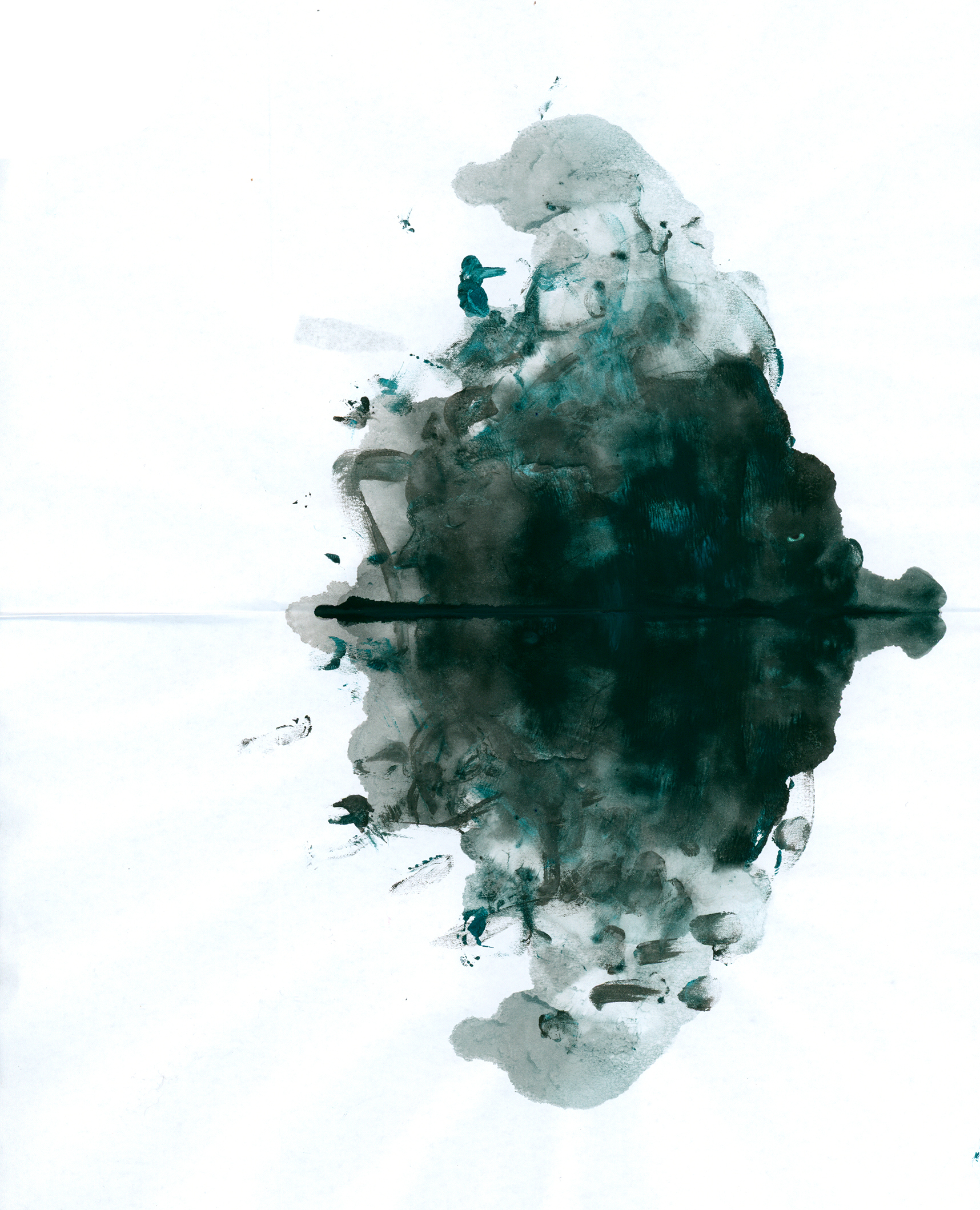
Hello again. Here is my last (I think) post in response to the Rorschach Test prompt from the Kick-About challenge hosted by Phil Gomm. This is my fully analogue response.
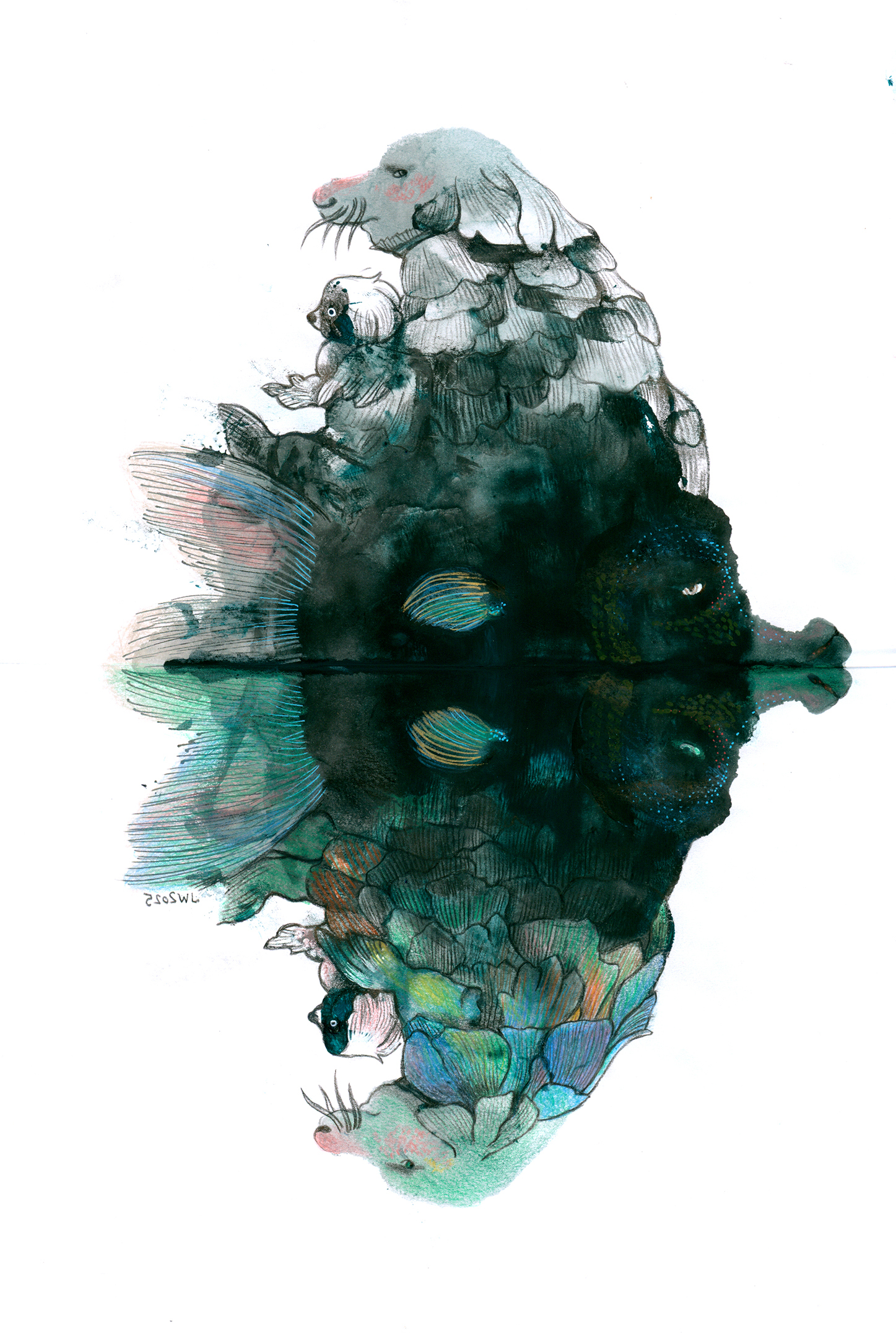
This inkblot looks EXACTLY like a lugubrious Long-nosed WhaleFish swimming across the surface of a lake carrying a weird, slightly menacing figure with a smaller figure on its lap.
It looks like that to you too, right?

So I tackled this one with Polychromos pencils and Posca pens. I really wanted it to be travelling left to right (English language picture book illustration is now in my bones), but when I was most of the way through, it looked better up the other way, mainly because of the colour in the water reflection.
I’ve refrained from ‘cleaning up’ the image in PhotoShop in order to remain true to its hand-made inkblottiness. All I did was dot a bit of white Posca pen to some of the more intrusively messy marks. So here it is.
Dogfish with Piebald Child riding a Long-nosed WhaleFish who is Really a Prince Under an Enchantment. If you want to rescue the prince, you’ll probably have to climb a mountain, wearing slippers made of prickly pears, and retrieve a plum from a magic tree that only fruits once every 50 years. Then come back and feed it to the fish… or something. I wish you luck. There’s no guarantee that he’ll be a nice prince when he is human again, so you’d better be on your toes, if you haven’t lost them to frostbite.

Below I’ve flipped the image so that you can compare it with the original ink blot.
Hello again. I’m not finished with ink blots for the Kick-About. And I‘m not finished with islands reflected in still water.
It’s not the first time I’ve gone down this road. I remember printing dozens and dozens of icebergs and islands for When You’re Older. In some illustrations I was conflicted because I liked the reflections on the water surface, but I was also enchanted by the creatures underneath the surface.
Question: How to have both in the one illustration?
Answer: Not easily.

But back to the current time! Yes, I did produce something new for this Kick-About prompt. The theme makes me think of (self) reflection, and it seems the world is full of people who see themselves in different ways.
Some don’t like what they see.
Some delight in it.
Some refuse to look at themselves at all.
Some see a version of themself that is invisible to others.
And the opposite is also true.
I sketched 12 small characters with dip pen and ink, to place into a scene of self reflection. Here are a few of them. (below)

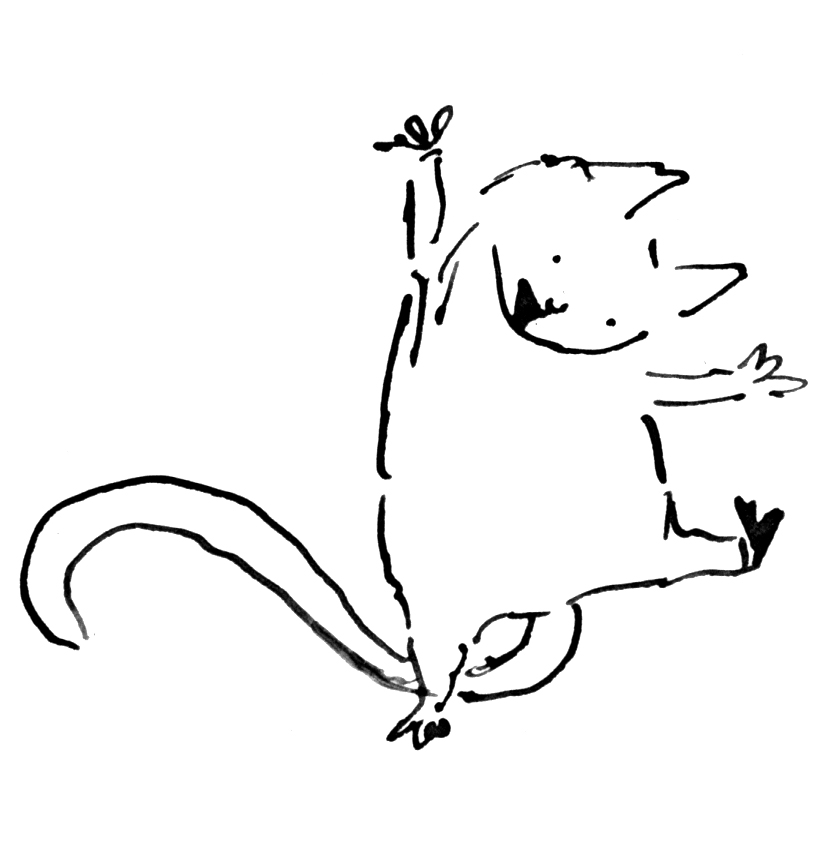


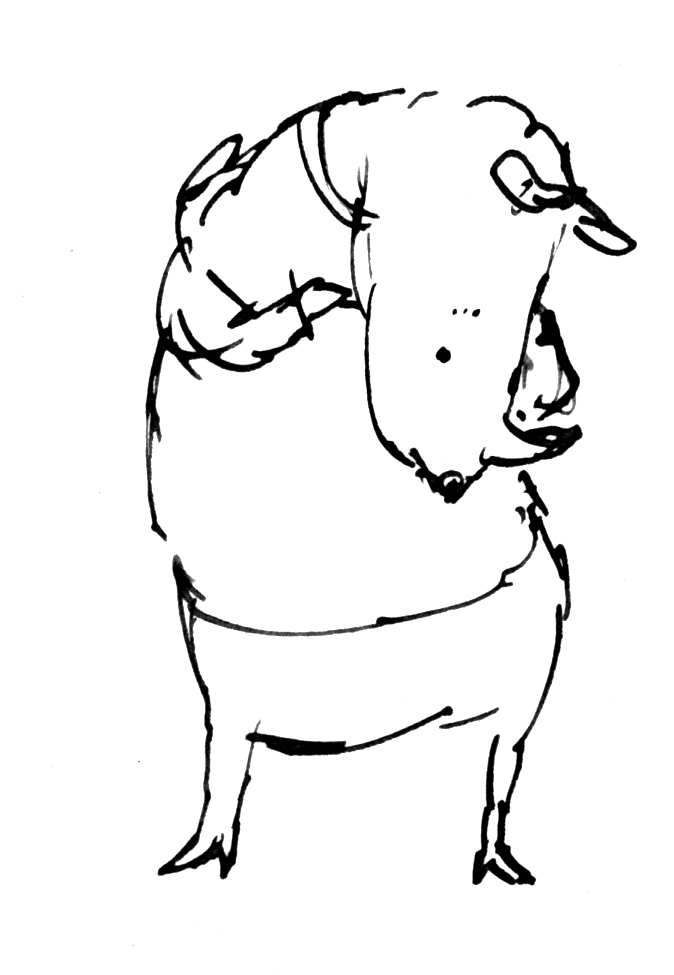
Then I printed a few ink blots. A couple really do look like very interesting moths, (I’m not sure what that means about my personality type) and they are begging to be used as collage materials for something else. But they don’t suggest islands to me, so I used the more solid results.
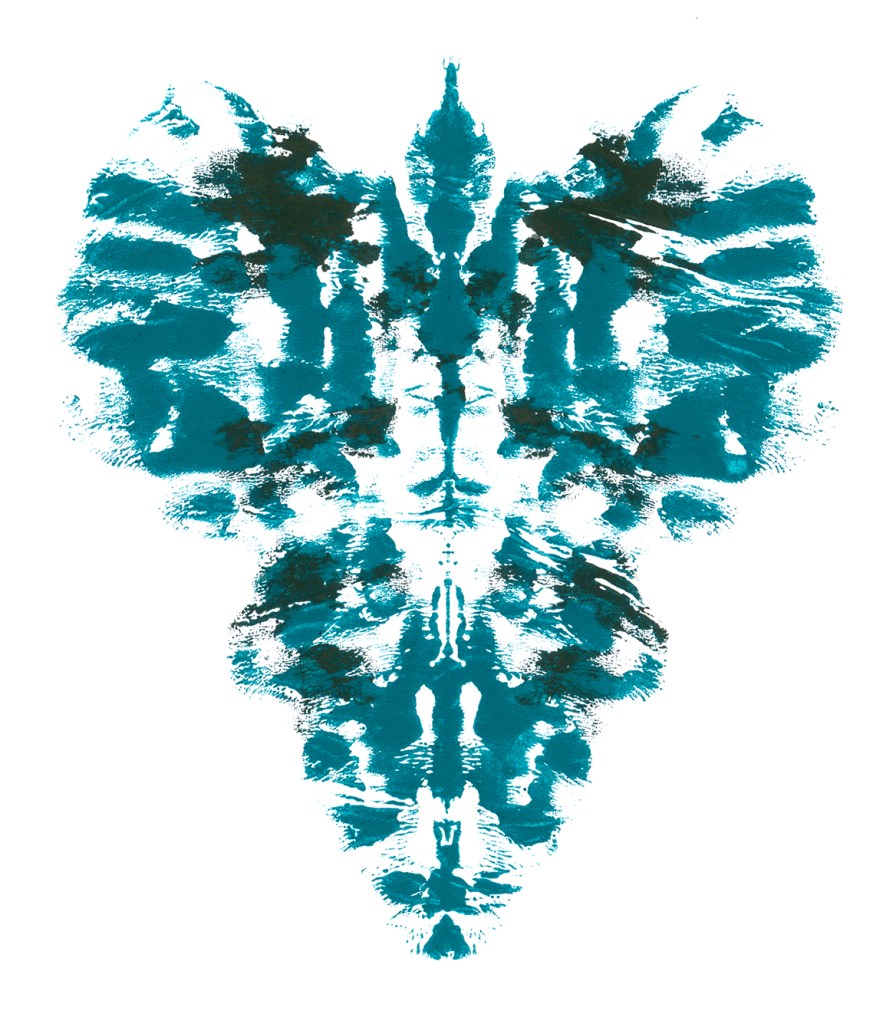
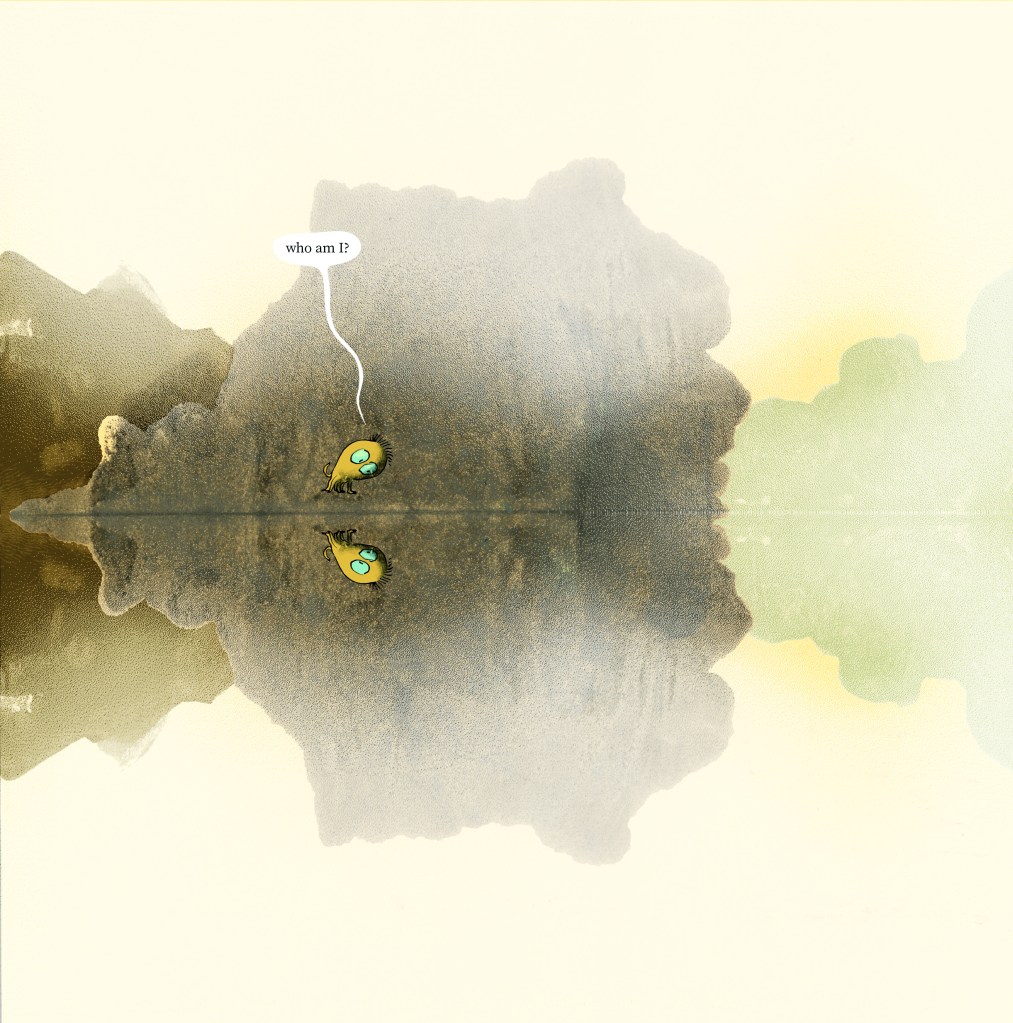
This ink blot on yellow paper is so evocative of a rocky island, that it didn’t need my interference at all. And the yellow just added to the atmosphere. But I wanted to use at least one of my characters, so I added some mist, and background islands, and then put my character in.

I was quite pleased with the result, and I feel for this little creature having an identity crisis, all alone. Although the text is at a scale that would work best on a full page illustration, and is probably illegible at this size.
And then I played with a second character with no background at all. I think this funny little creature is a cousin of the legendary Narcissus, but if you flip the image upside down, you have the more universal experience of looking in a mirror.
Most people are familiar with the Rorschach Test invented in 1921 by Hermann Rorschach. It‘s so often used as a gag in a cartoon or a sitcom that even youngsters get the general idea. It’s a psychological test, where a patient looks at the ink blot and describes what they see in it – often an animal, face or scene.
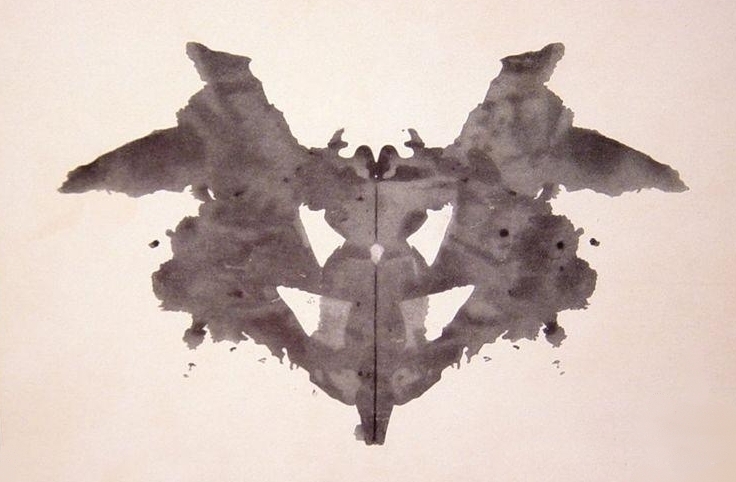
But I wasn’t aware that Klecksography was a thing in the late 19th century. Making images from ink blots, it’s an activity that I often enjoy as a warm-up exercise for drawing, and to create new characters. I usually call it blob drawing, which isn’t nearly as fancy, but I suppose my blobs are a bit more blobby in shape than blotty, and they lack the symmetry too.
I thought this prompt was a great opportunity to join in the Kick-About again, because I already have some artwork to begin with, and it’s not my collection of blob drawings. It’s this illustration (below) from my upcoming picture book with Kyle Mewburn, Jo and the NO. In this illustration, Jo traverses ‘lakes as still as mirrors’. So creating background mountains and their reflections from Rorschach-style inkblots seemed like a good idea.

Here the NO in the back of the punt seems to be observing itself in the still waters because I wanted to suggest self reflection as well as the physical reflection of the scenery. You’d think it would be easy to whip up a few inkblots and plonk them into the image. But it was surprisingly hard to get from the successful rough illustration (below) to a successful final illustration.
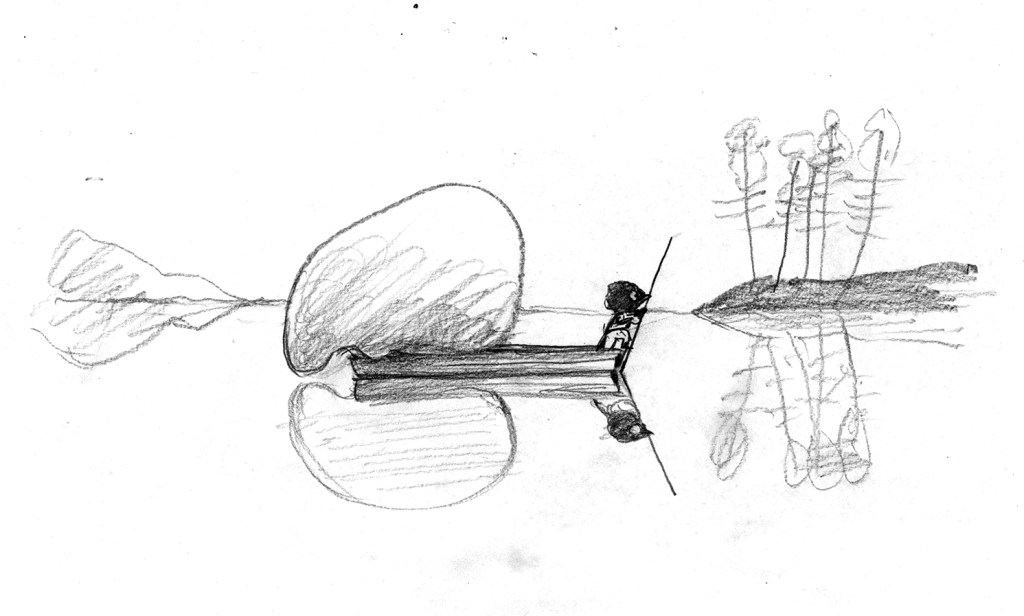
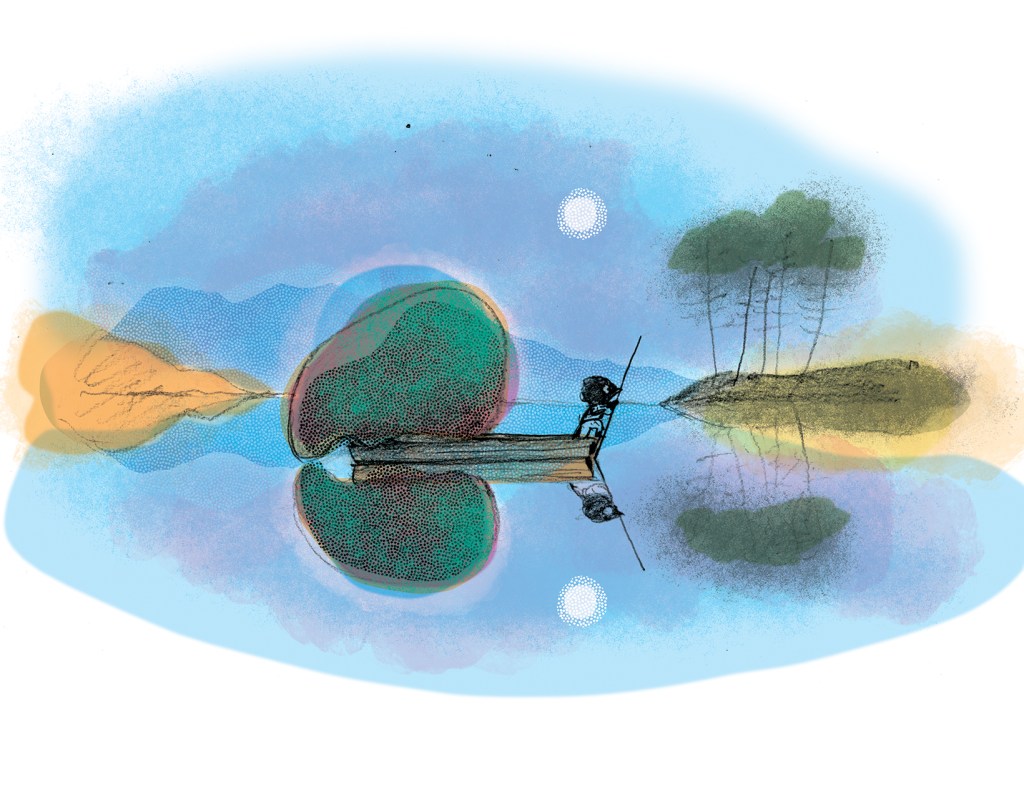
The original sketch started as a thumbnail drawing, intended to share a double page spread with three other vignettes. But when we decided that the book was going to 40 pages this scene acquired a double page spread of its own with the impediment of the gutter down the middle of the illustration. So getting the balance of the illustration to work again in a different format was a challenge. The enlarged range of mountains and trees when loaded together on the page, very quickly distracted from and overwhelmed our protagonists, instead of highlighting them and giving significance to them.
Also I didn’t want my reflections to be perfect, because imperfect things are always more interesting and have more visual energy. But I found that if they were too interesting, they became distracting. So there was a lot of trial and error involved with recreating the transparent freshness of the rough sketch within a new framework.
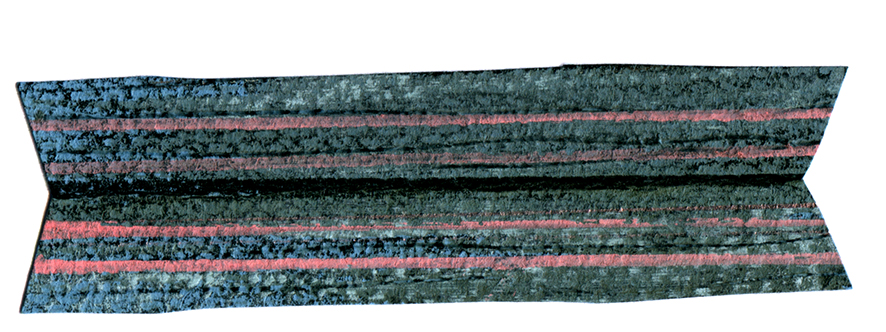
Below are a few of the monotypes I produced to create islands and mountains for the background. I painted a loose shape, suggestive of an island with vegetation, and then folded the paper in half for the reflection.

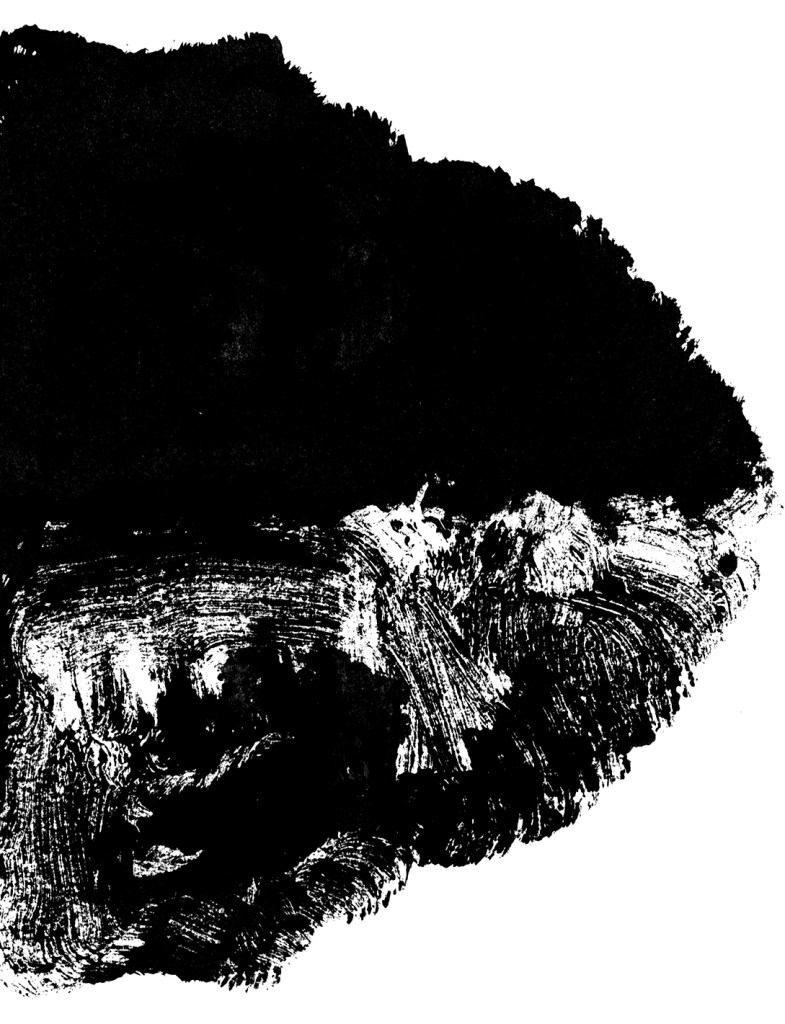


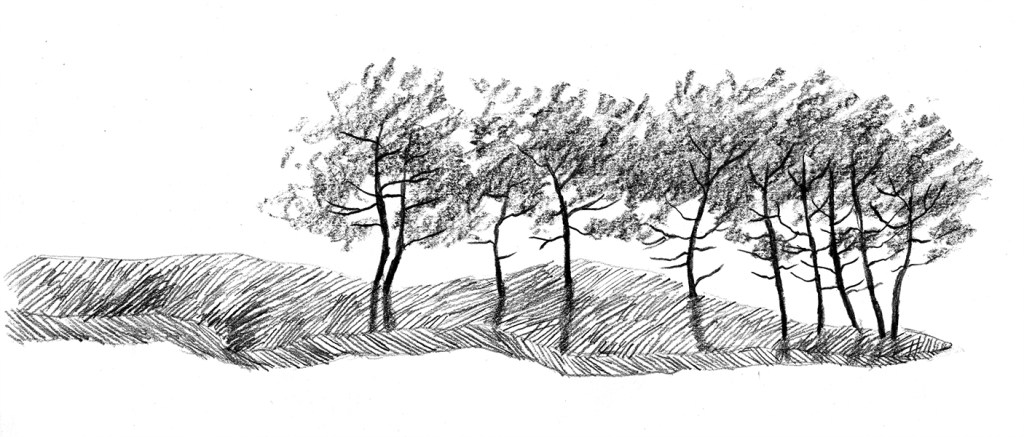
Below are some of the more detailed experiments, testing out graphite instead of paint. These fell into the too distracting category. There are always countless illustrations made for a picture book (some of them very time consuming) that don’t make the final cut. But they may be interesting in their own right.

And I have to include the other hand-made element – a little collage boat made from Ingres paper and soft pastels. It’s so nice and wonky. One of my favourite bits.
For the final art, I did end up using a digital reflection for some elements, and those reflections did become ‘perfect’. But most of the tree reflections were drawn by hand and so they don’t perfectly match their right-side-up counterparts. (This brings about a nice effect used by landscape architects, where a repeating pattern with small variations is pleasing but never monotonous.) Embracing these inconsistencies was part of my journey of letting go of hard rules.
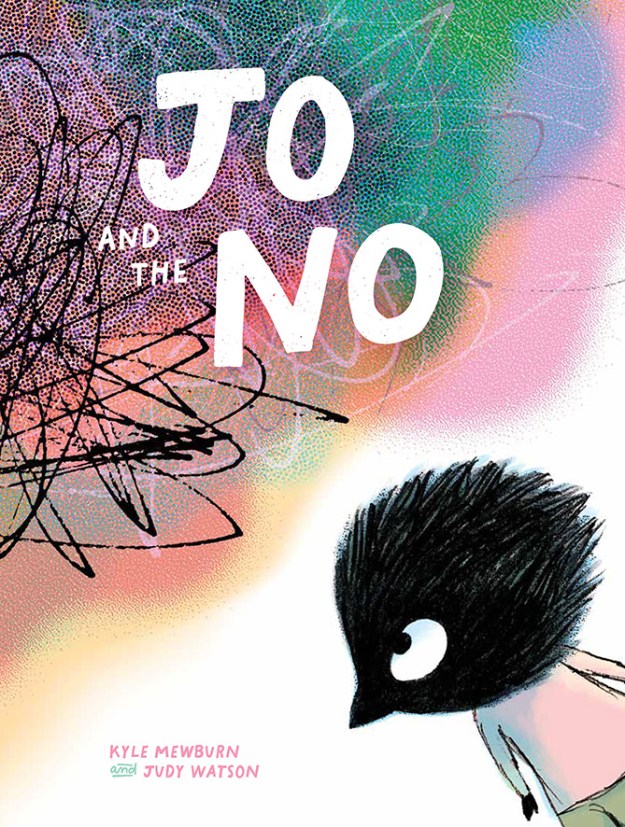
More on Rorschach ink blots in the next post. In the meantime, anyone who is interested in pre-ordering Jo and the NO, please click here or on the cover image below.

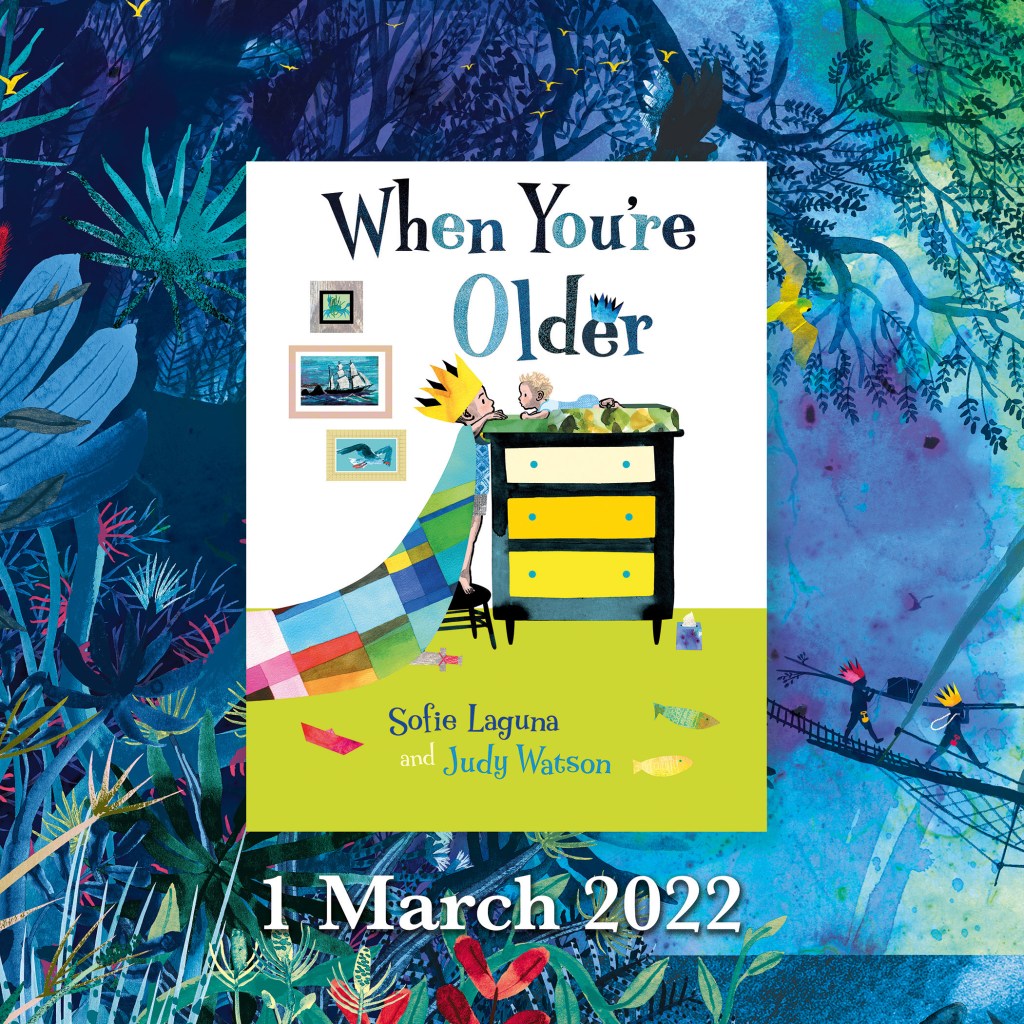
On the first of March When You’re Older will be in bookshops. Hurrah! And I’ll be in two of them on the same day, decorating the windows to celebrate the release of the book. I’ll be starting out at The Little Bookroom and then zipping across to Readings Kids.
I’m really happy with the cover. We went all over the place exploring cover options, including under the sea and up a tree. But this one feels right. The focus is squarely on those two faces. They’re the heart and soul of the book. (I admit I’m a bit infatuated with the chest of drawers, too.)
Book designer Sandra Nobes did an amazing job with the typography. Her title lettering expresses the tall and short of our two characters, complete with small crown. And her selection of typeface for the creator names took inspiration from my hand-drawn letters and is a near perfect match with a few less curls. (You can see my curly writing above, with a baby seemingly floating over it!)
If you’re thinking the book is about nappy changes, don’t be fooled by the box of tissues, although you might need one yourself. Perhaps, like me when I first picked up the manuscript, you’re thinking that the book will be about sibling rivalry. It’s not.
Inspired by hopes for her own two children and interestingly by the imprisonment of journalist Peter Greste in 2013, Sofie Laguna’s words are about love and about brothers looking out for each other. About a big imagination. A big world. A big adventure and big danger.

There are also lots of tiny things.
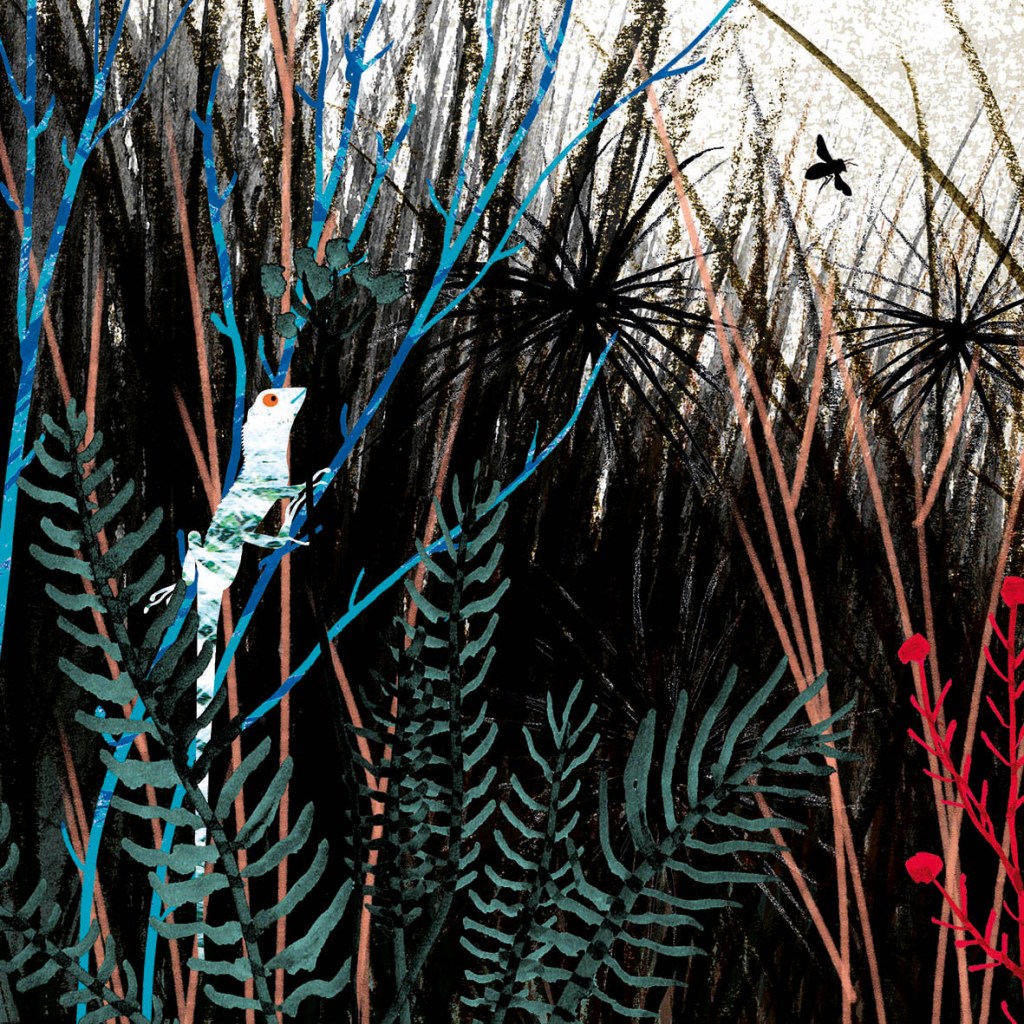
One of the great joys of parenting small children for me, was the experience of reading aloud to them. I loved to witness their immersion in the world of each picture book; their interaction with the page as well as the story, fingers keenly pointing out the important parts, and often the tiny details. So while I was working on When You’re Older, I imagined little hands holding the book and little fingers pointing. Every lizard, butterfly and bird was made for this purpose. Every footprint in the snow.
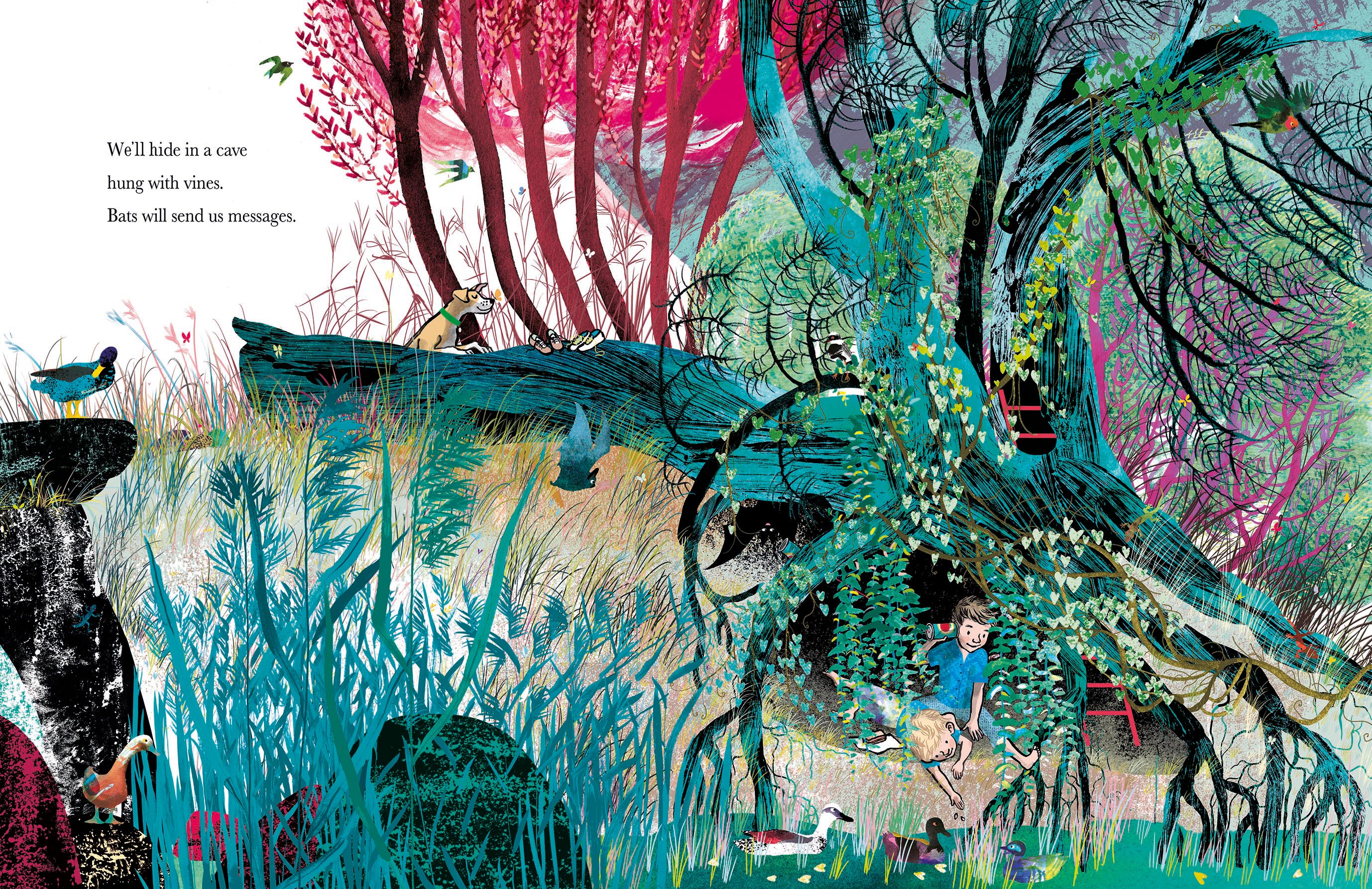
I think there will be much counting! How many birds can you find? How many bats? Ducks, lizards, butterflies? These small things are only footnotes to the main story, I know. But I am so looking forward to seeing some real fingers exploring the book.
Please pop in and say hello if you’re in Melbourne on 1 March or in Mornington on 4 March. There will be signed books available to purchase. I’ll be the one with the paintbrushes and Posca pens, decorating the windows. And I look more or less like this.


Two books in one year is outrageous for me. I’m a slow cooker of books. Especially picture books. Each one is for me such a journey of discovery and striving and learning and change. So they emerge slowly.

But speaking of emergence, this is a book about cicadas… cicadas emerge slowly too! Some of them spend several years underground in their nymph form. One species spends seventeen years underground, which is longer than I have ever taken to illustrate a book… thankfully. Then they dig their way up into the light, shed their outer casing, dry their wings and sing a song to the summer. The boys do, anyway. And I’ll bet not many people know that they cover their ears when they are singing so that they don’t deafen themselves. Lesley taught me that.

There are so many bits of fascinating information in Lesley Gibbes‘s text. And there are more than insects here too. There’s a narrative featuring a grandfather and child who go looking for cicadas on an overnight camping trip. And that is what I call fun.


Cicadas, summer and grandparents go together like cheese and biscuits. There’s something about these wonderfully noisy creatures (the cicadas, not the grandparents) that fascinates adults and children alike, and while we are sharing our fascination, we share a time, that later becomes a treasured memory. It did for me. I remember holding cicadas on my hand and collecting the empty shells (exoskeletons) and attaching them to the front of my clothes by their hooky little feet. They looked very decorative, along with the ripe cherry earrings hanging from my ears.

I consider myself lucky to have been offered the opportunity to illustrate a Nature Storybook for Walker Books. It’s a series that I’ve admired for a long time. It features a double layer of text; story and scientific fact alongside one another in a child-friendly format. There are quite a few in the series, all beautiful. (I’d love to own an original painting from Dingo by Claire Saxby and Tannya Harricks. And check out Tannya’s dog paintings!)

A few years ago I did quite a bit of illustration work for Museum Victoria where I got a taste for illustrating New Things That I Knew Nothing About. You research, scribble, take notes, panic, draw, draw again until you get it right… or right enough. (It’s never perfect.) This was a bit like that. It was really satisfying to learn to draw a cicada. I’m not confident I’d be able to draw a convincing one now, but for a few moments in time, I could do it.

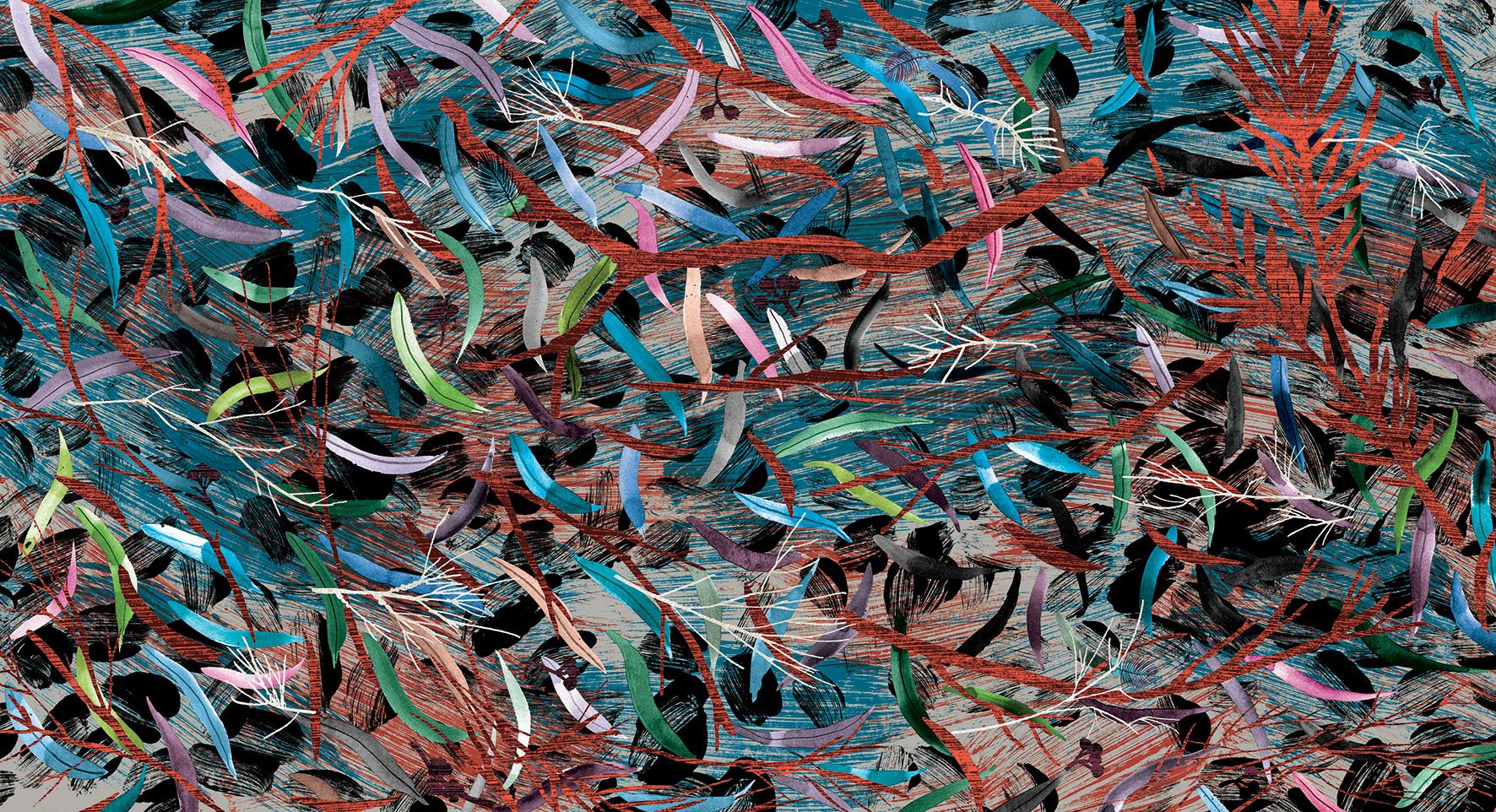
And best of all was illustrating the Australian bush and the leaf litter. It made me want to make great big paintings of leaf litter.


(a Cornish Rex of course)
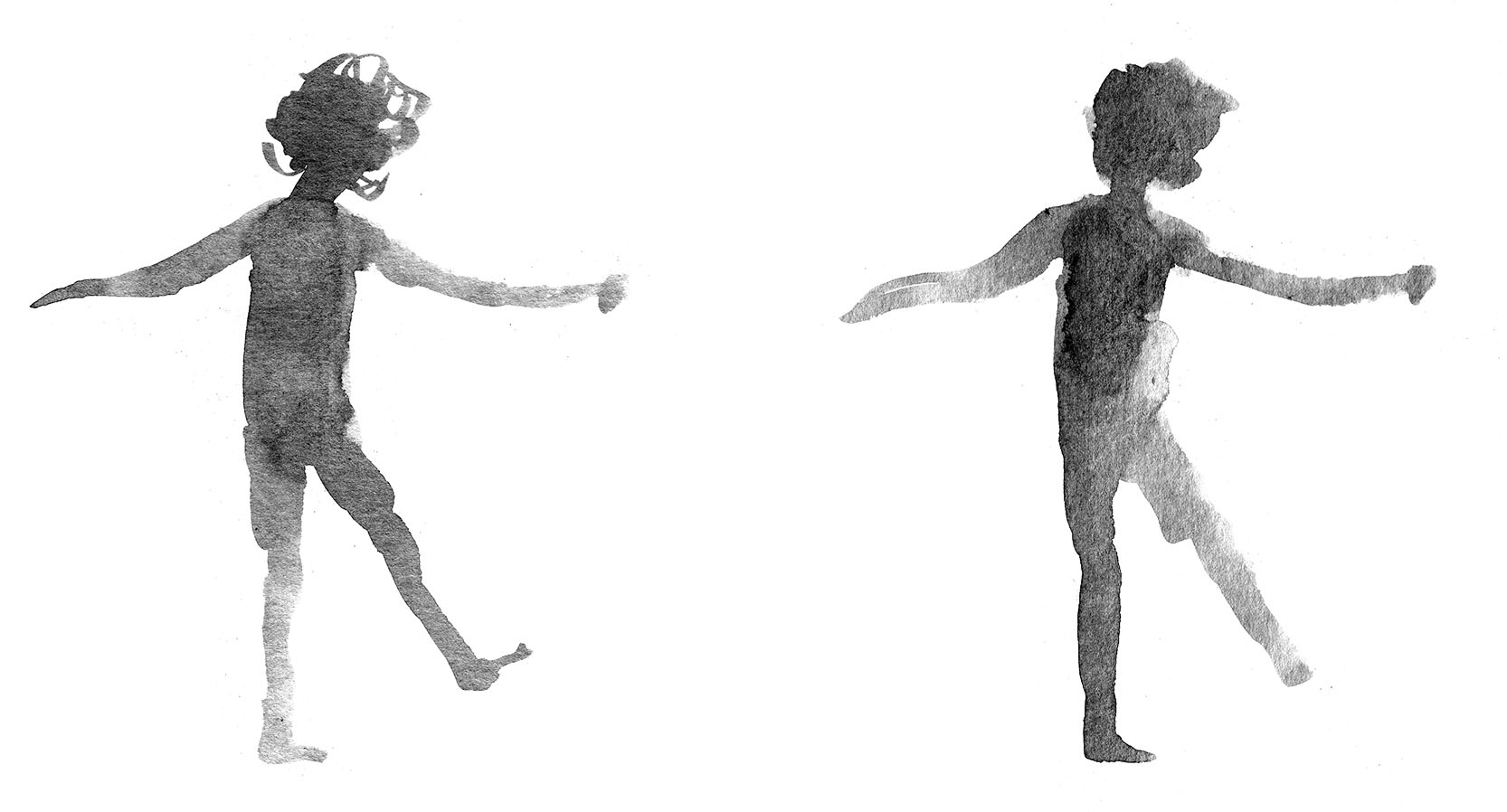
Work in progress (a fragment) for page 8/9 spread of Thunderstorm Dancing.
 Judy Watson