Category Archives: creative process

Leonard’s Fluffball Moment

(or… Raise your Darlings from the Dead)

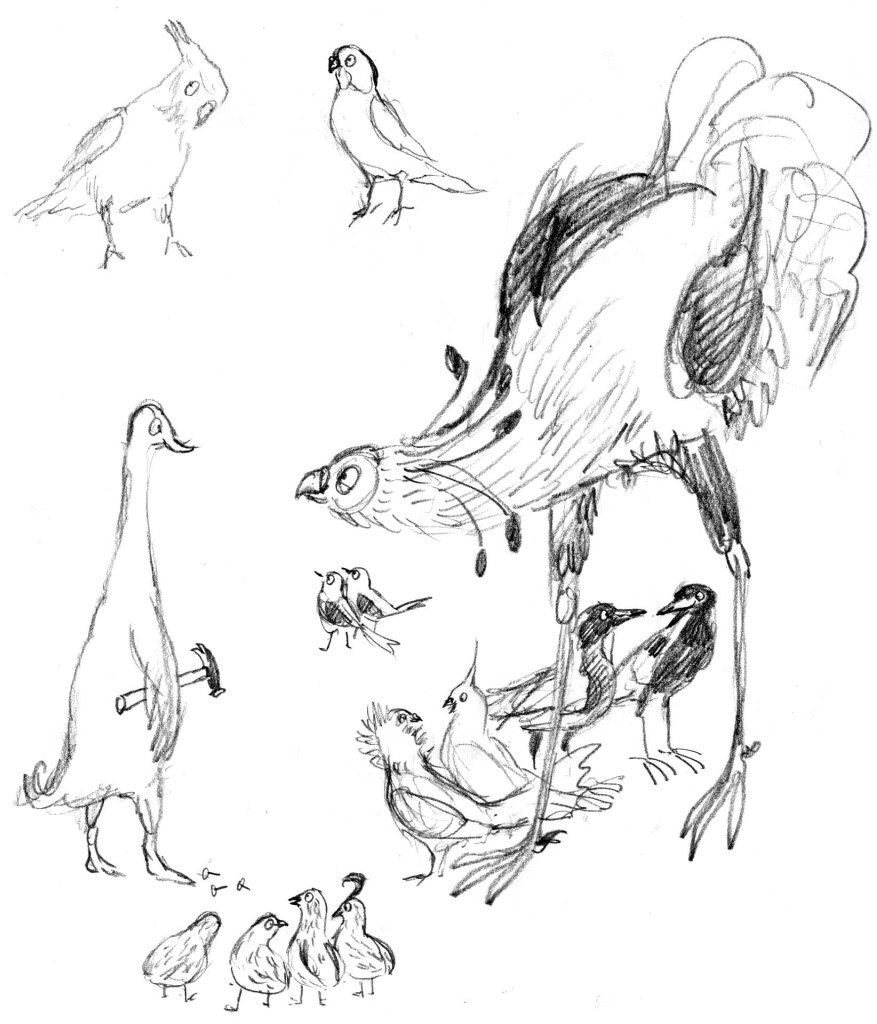
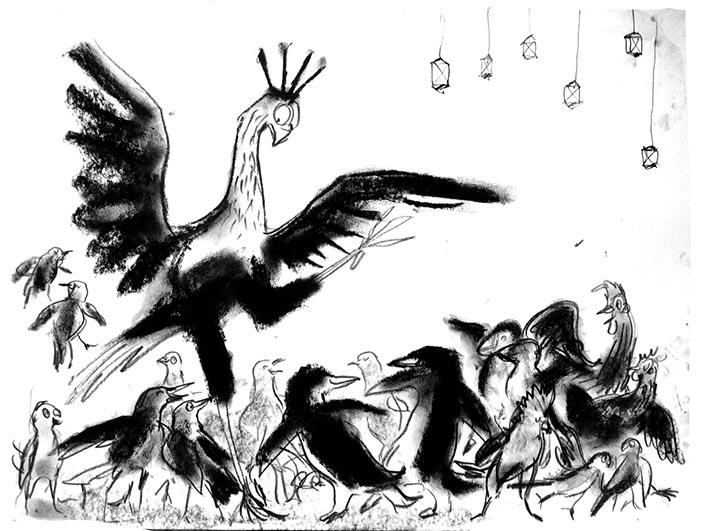
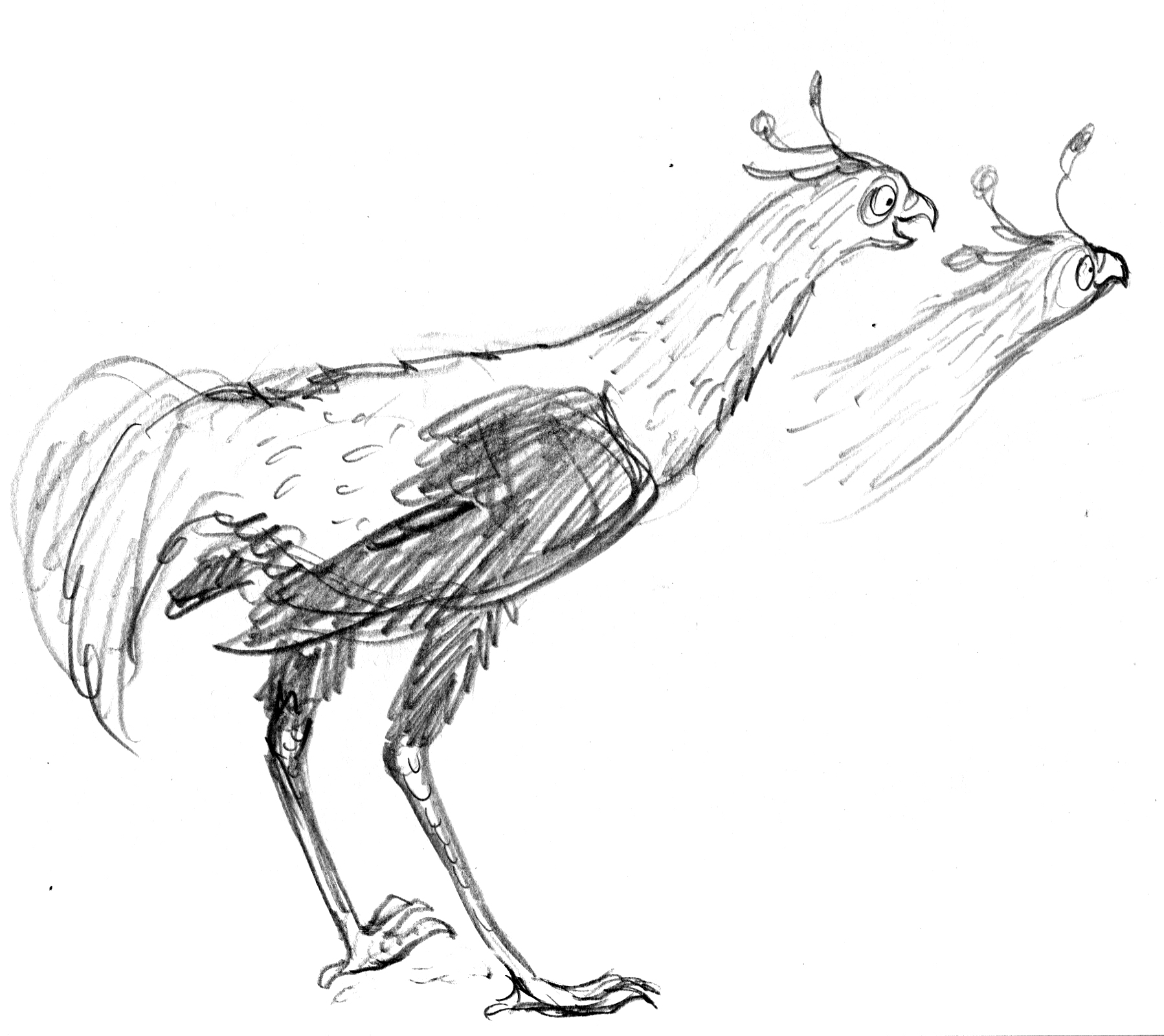
One of the early sketches for page 4 of Leonard Doesn’t Dance. It features some darlings who survived and some darlings who were killed off. (The duck was replaced with a penguin, poor darling, and didn’t even get featured on this page.)

When illustrating for children’s books, we are helping to teach children empathy, which is enormously important for their future wellbeing, and for the wellbeing of our world. So drawing a character’s feelings in a way that children can relate to, or ponder and begin to understand, is Number One for me. It takes precedence over aesthetics and character continuity.

Big-beaked Leonard. His rapture was important and his beak said this best. Hence, a big beak! The crest was a great bonus for expressing mood on every page. Here, it’s excited, but hesitant…

This means that I often approach the end of an illustration project and look through it to find that I have not one leading character, but several variations on that character. Sometimes it bothers me and I change the artwork if time allows. Leonard is pretty variable throughout Leonard Doesn’t Dance, sometimes thicker or thinner and his beak varies from one page to the next. Sometimes he has enormous wings, and other times, they’re stubby. Does it bother me? Nope. He’s still the same gawky, tender-hearted, enthusiastic and loyal fellow throughout. And his feelings are written large on his face and in his body language. I’m happy with that.

Sad, sad Leonard. Here, the beak says less. Although it does have a downward turn. The wings, crest, eye, tail and body posture all say ‘MISERABLE’.
An early sketch for page 25. The wings and foot outstretched, express Leonard’s discomfort. He needs to look out of place in both in scale and mood.
Detail of final art for page 25. Leonard’s wings and raised leg have been even further exaggerated, although his face and head size has been brought further into line with other illustrations.

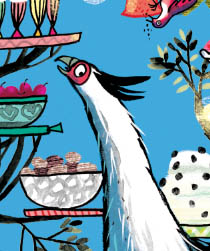
Late in the process of illustrating Leonard, I noted a few pictures that could do with tweaking, to make Leonard more consistent. One of them was this image of Leonard just out of bed, reading a notice about the Big Beaky Bird Ball.

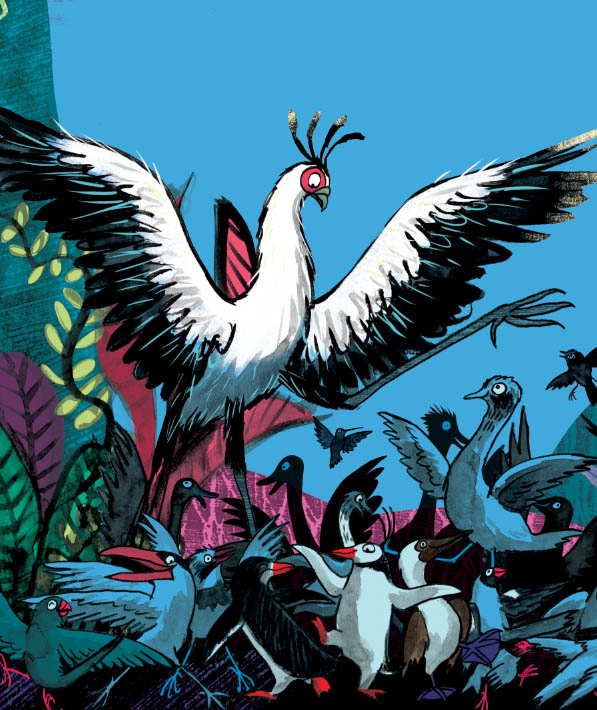
Detail from page 4 of Leonard Doesn’t Dance, published 2019 by ABC Books

The drawing for this one had been done early on, (see the sketch at the top) and my ‘Leonard shorthand’ had developed since then. Later on, he had a longer, narrower neck, looser curves on his toes (yes, I actually think about those things) a smaller body and bolder black and white contrast – he looks less fuzzy and soft in later illustrations.

The later Leonard, less fuzzy, less smudgy. A smaller head and a slinky neck.

I really loved my page four Fuzzy Leonard, but I redrew him. I killed my darling. I lengthened his neck and made other tweaks. I finished the illustration and went back to other edits for other pages.

Finally, I came back to page 4 and looked at it. I had loved this scene. It had made me feel so warm and fond of Leonard. He reminded me of a 3 year old in pyjamas, just out of bed with his hair all fluffy and squashed and his face all soft and sleepy.

Somehow, though the character was now more consistent with other pages, the joy was gone. Somehow, the Leonard I loved was no longer there. At the eleventh hour I raised Fuzzy Leonard from the dead. I must have very fine necromancy skills because he was just as loveable as I remembered him to be, and he didn’t show any zombie tendencies at all.

Character continuity…
I’m conflicted about it.
I do realise that if I found it easy I wouldn’t be conflicted about it…
Did Charles Schultz ever have these problems?

An Intoxication of Elements

(or Kill Your Darlings)

Poor dangling darlings

When I’m illustrating a page for a picture book, I sometimes find that I capture a mood that expresses the meaning of the text in a very rough form. It feels right, but it’s just a framework. When I work on the final art for that scene, I add layers of detail, making decisions as I go along, and at some point, the juxtaposition of colours and shapes becomes intoxicating.

Once intoxicated, I find myself off on my own little adventure, with my eyes open in wonder at all the pretty colours, textures and shiny things. And then at a certain point, (often when I place the image into the layout to check the flow of the narrative) I find I am hit with a bucket of cold water.

Sober up, Sister. All the shiny things are beautiful. But they don’t work on the page.

Or they don’t work with the text anymore, or they don’t work with the sequence of illustrations. The original truth has been lost under the shiny things. And then it’s time to kill off my darlings. That phrase applies to illustration just as much as writing.

For example, this week, I’ve been making a ghost ship for my current picture book project When You’re Older by Sofie Laguna. It’s my first ghost ship, in my first enchanted lagoon, with my first ghost pirate. The ship is fun. I’ll need to paint it again, because it isn’t there yet but I can see it’s going to work. Yay! Under the ghost ship, there is a mermaid swimming. Yay! And everything is all blue and green and wet and shimmery and deep looking. But to make it truly ghostly it needs some heavy weed and barnacles and stuff hanging from the hull in a dark, spooky but beautiful way, right? Of course, right.

This is where I got intoxicated.

Oh boy! You should see what happens when you start layering up seaweed under a black ship in a turquoise sea! You seriously can lose your head!

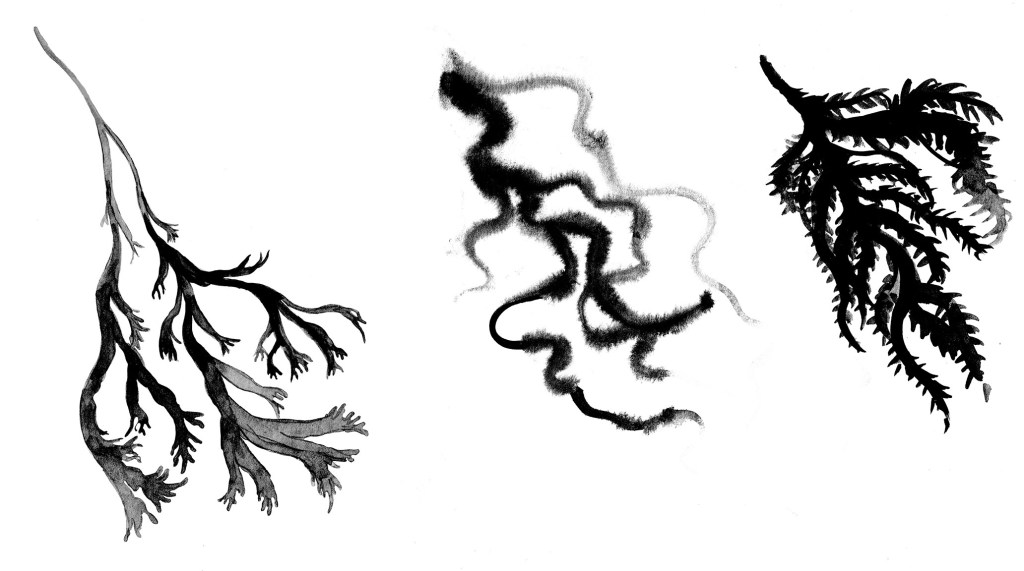
These were my building blocks.

I started with this.
Then I made some smaller embellishments. The wet one was key. I wasn’t so chuffed with the one on the right. But we’ll see. Mmmmm.
I’m looking for that HEAVY draped look. So heavy, the ship is just drifting slowly, groaning, becalmed.
Wait, I might want the weed to drape deeper, and and to curl forwards to enveloping the mermaid. So here are some wild and woolly tentacle-weeds.

Then I put them on the image, with the ship and a few mermaids. (This is a corner detail.)

There are already too many mermaids, but the weed is making me tipsy.
Deep dark squelchy, wet bits contrasting with hard, branchy drawn bits
Oooh, that purple is going crazy in there.

My psychedelic dream here came to an end. The page needed a rock or island in front of all this weed, in order to give a sense of the waterline, and to visually anchor the image on the page. With the weed visible in the bottom right hand corner of the spread, all the energy was leaking off the page. No, not leaking …pouring torrentially.

Besides this, was all this weed adding anything to the mood, the action or the experience of the main characters? No.

So I have killed some darlings. I’ve taken it all back to serene. Sorry. You can’t see that yet.

But I’ve added a skeleton. But not one of those up top. And some palm trees… Yay!

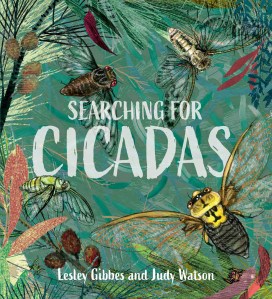
Searching for Cicadas

A book about summer and family… and cicadas of course

Two books in one year is outrageous for me. I’m a slow cooker of books. Especially picture books. Each one is for me such a journey of discovery and striving and learning and change. So they emerge slowly.

Portrait of the artist as a very young person, before I illustrated this book.

But speaking of emergence, this is a book about cicadas… cicadas emerge slowly too! Some of them spend several years underground in their nymph form. One species spends seventeen years underground, which is longer than I have ever taken to illustrate a book… thankfully. Then they dig their way up into the light, shed their outer casing, dry their wings and sing a song to the summer. The boys do, anyway. And I’ll bet not many people know that they cover their ears when they are singing so that they don’t deafen themselves. Lesley taught me that.

The skeletal pencil and ink background of a spread from Searching for Cicadas
Ghostly shadows of the child figure for the same spread
The spread with colour and characters added

There are so many bits of fascinating information in Lesley Gibbes‘s text. And there are more than insects here too. There’s a narrative featuring a grandfather and child who go looking for cicadas on an overnight camping trip. And that is what I call fun.

Dirt and pine needles between the toes. Nothing beats bare feet.

Cicadas, summer and grandparents go together like cheese and biscuits. There’s something about these wonderfully noisy creatures (the cicadas, not the grandparents) that fascinates adults and children alike, and while we are sharing our fascination, we share a time, that later becomes a treasured memory. It did for me. I remember holding cicadas on my hand and collecting the empty shells (exoskeletons) and attaching them to the front of my clothes by their hooky little feet. They looked very decorative, along with the ripe cherry earrings hanging from my ears.

summer days in the country with my brother and Mum. I have no cherry earrings on in this photo.
Soundtrack: cicadas, magpies

I consider myself lucky to have been offered the opportunity to illustrate a Nature Storybook for Walker Books. It’s a series that I’ve admired for a long time. It features a double layer of text; story and scientific fact alongside one another in a child-friendly format. There are quite a few in the series, all beautiful. (I’d love to own an original painting from Dingo by Claire Saxby and Tannya Harricks. And check out Tannya’s dog paintings!)

Camping with Pa: bliss!
Soundtrack: cicadas, magpies

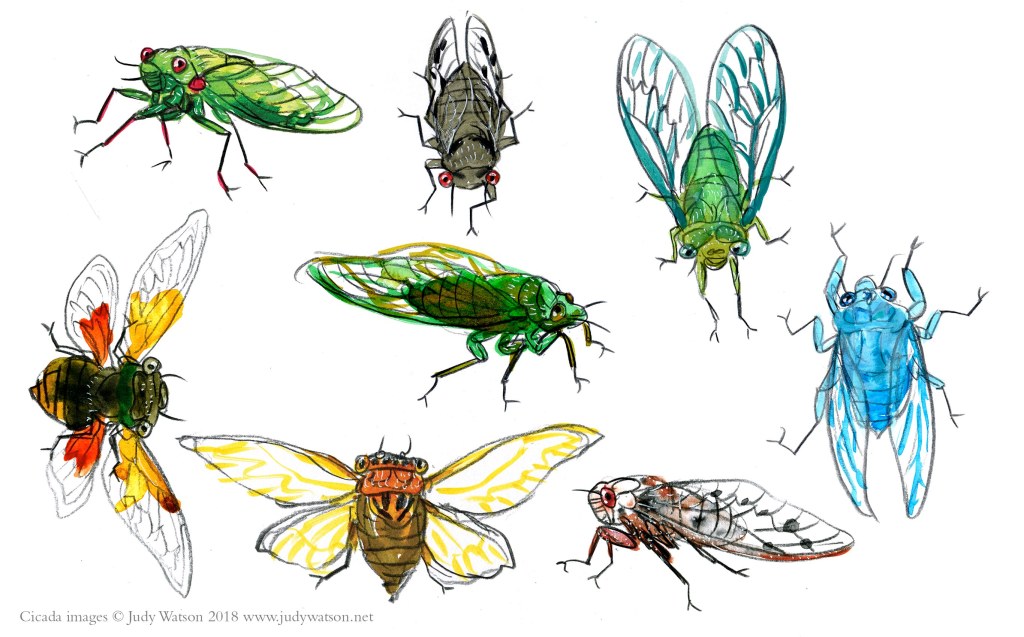
A few years ago I did quite a bit of illustration work for Museum Victoria where I got a taste for illustrating New Things That I Knew Nothing About. You research, scribble, take notes, panic, draw, draw again until you get it right… or right enough. (It’s never perfect.) This was a bit like that. It was really satisfying to learn to draw a cicada. I’m not confident I’d be able to draw a convincing one now, but for a few moments in time, I could do it.

This was my favourite cicada. He didn’t make the cut. I think it was because he had just a bit too much personality for a non-fiction title. He is my little friend.

And best of all was illustrating the Australian bush and the leaf litter. It made me want to make great big paintings of leaf litter.

Me with my grandfather, the irrepressible Pop Worrall who wasn’t with us for long enough. We never went camping but we did lots of swimming together.

Leonard galumphs into bookshops

I nearly wrote ‘Leonard dances into bookshops’. But then I remembered that Leonard Doesn’t Dance… or does he?

Leonard doesnt dance detail.jpg

I’m very fond of that great galumphing bird. I relate to him very much. The initial enthusiasm, the self doubt, the impulse to hide away in a thorny tree, the desire to be with my friends that usually draws me out of the tree. And like Leonard, I have some fabulous friends.

My thanks to the team at Harper Collins and to Frances Watts, for patiently waiting for Leonard as he put one lanky leg in front of another (tripping over several times) and eventually became finished art; now a book.

This lovely cover was designed by Hannah Janzen.

I had been initially drawn to a white cover, because black ink on white paper was a signature part of making the artwork. There was a lot of ink involved. Brushed on, drawn on, printed, wiped and smudged onto white paper. Big broad strokes, and fine textured marks. So my original idea was to have an inky black and white cover, with a pop of red on Leonard’s face, and a scattering of brilliantly coloured birds flung around it like a double handful of lollies, and wrapping around both covers.

The team at Harper Collins didn’t think the white design was indicative of what was inside: a rampant world of jungly colour. This was perfectly true, and is why editors are so great! and Hannah did a fabulous job of designing something rich and celebratory.

Here are some of the lolly birds from the white cover design. Some of them found their way onto the new cover anyway. Perhaps you can spot them.

I visited the Grade Sixes at Derinya Primary School a few weeks back and we had a great time talking about Leonard Doesn’t Dance, story arcs, tension and making storyboards for picture books. There is just so much to talk about! A two hour session went by in a flash. I will be signing up with Creativenet Speakers’ Agency very shortly, so if any schools or groups of lovely librarians within Cooee of Melbourne would like to book a workshop and talk with me, that will be the place to go.

I have another book released this month as well! A very leafy book about cicadas. More on that soon. Enjoy your week!

Here I am

After the longest time!

Hi there. I’ve missed you. Work on Leonard Doesn’t Dance is going well. And I’m also working on another exciting project. A picture book by Sofie Laguna called When You’re Older. It’s a bit tricky working on two; just when I’m submerged deeply in one, I have to haul myself out by the scruff of the neck and focus on the other. But it’s fine, because both are lovely books.

Leonard and his pigeon friends are learning the can-can. I can’t do the can-can. (I might yet learn… A fake leg might be helpful.) But pigeons can can-can.

Here’s a small section of what I’m working on today. The background is in progress so the yellow area is sketched in. And all around what you see here are plants and other birds and a couple of beasts. But this is one of the white pages. The full colour pages look different.

Leonard and the Can-can pigeons

Detail of the can-can page from Leonard Doesn’t Dance by Frances Watts

They look like this.

Leonard colour page sample

Detail from a full colour page as the sun sets in Leonard’s world.

I’m using a big mix of media in this book. I’m printmaking, painting, drawing, collaging and digitising. (I’m doing the same for When You’re Older, but with a different colour palette.)

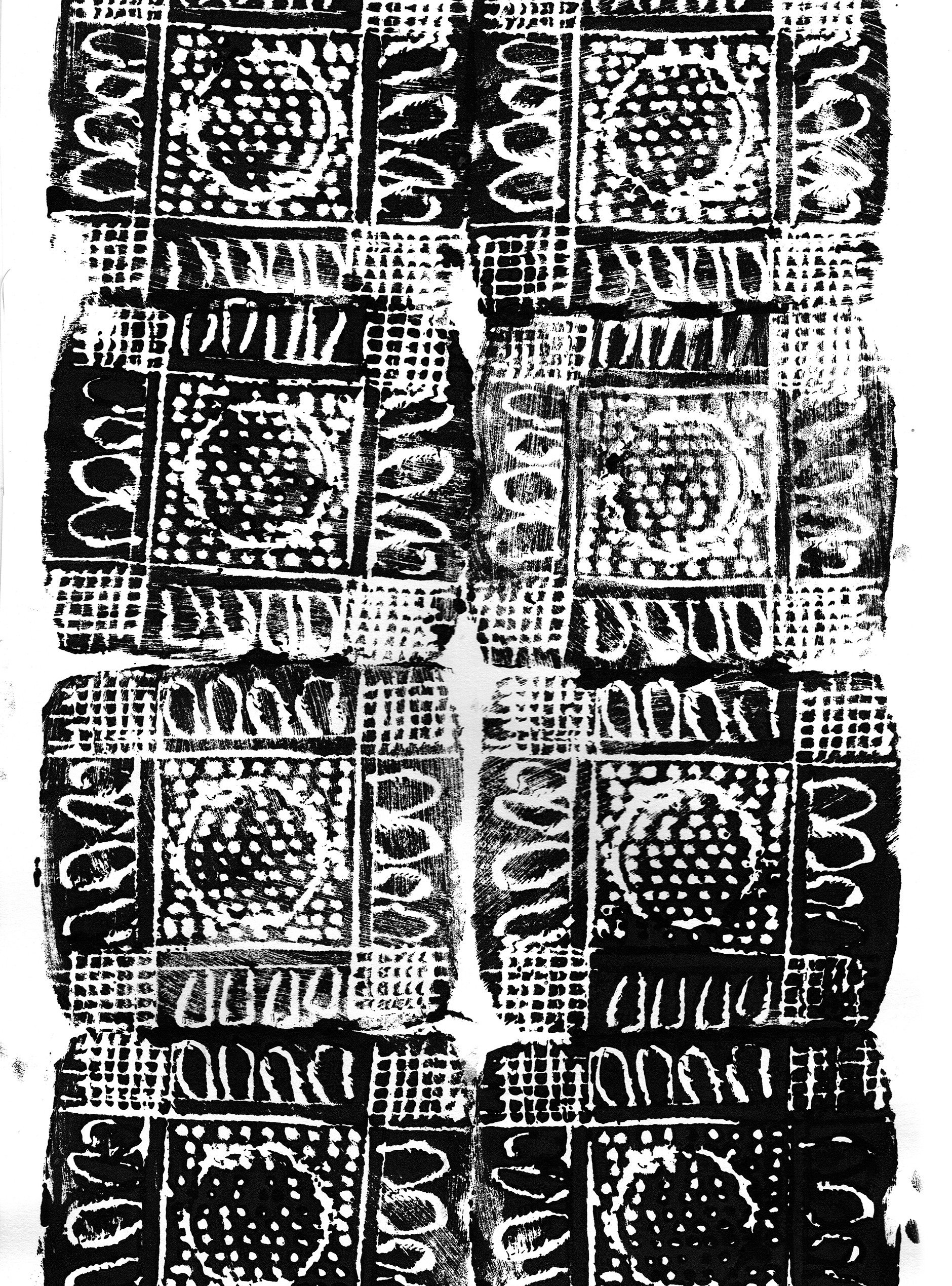
The printmaking is the most fun part. There’s something so intoxicating about printmaking. When the outcome is uncertain, due to the variability of the process, you are always on the brink of something… and it could be wonderful. It could be a treasure. Those op-shoppers among you will understand the feeling as it’s rather similar.

The print below is saved to my computer with the ignominious title ‘Disappointing Flowers’. But once colour and collage treatment are added, it actually works very well.

‘Disappointing Flowers’

This is a quick mock-up showing how the application of colour and a trim here and there, bring a disappointing print into a context that works. At least, for me. It’s not from the book.

A quick digital collage of my disappointing flowers to see if they rise to the challenge.

This one I was truly delighted with. It’s such a simple pattern, printed with a single block and roughly aligned. The roughness appeals to my deepest instincts in a way that nothing tidy or perfect can do. And the print has become a raw material like a delicious cheese that I might put into some cooking.

repeat pattern lores

Rough, ready and rambunctious, this print appeals to me like a Staffordshire Bull Terrier.

And here are some of the inky painted areas I’m using. These too, will be barely recognisable when I’ve finished colouring and ornamenting them on the computer, but for me, the shapes produced with a brush have more animation than anything I can draw directly on the screen.

8-9 tree shapes lores

Inky tree shapes for Leonard Doesn’t Dance… Or maybe for When You’re Older.

Now it’s back to the page. Some ducks are calling for my attention.

Yes. I think some of them are Call Ducks.


Studies in blue

Today I have been working on the mid section of roughs for Leonard Doesn’t Dance. It’s a difficult time for poor Leonard.

As I was drawing, in search of the right feeling in his posture and expression, I thought it might be interesting to picture book enthusiasts to see some of the thought that go into each illustration. So here we go.

Leonard RHS studies lores

An A2 sized page of studies for a vignette on page 15. (8 scans later, boy do I wish I had an A2 sized scanner!) I have numbered my drawings in order in case you are interested to see the progression of ideas.

I’m not sure if you’ll be able to read my notes on the page. Leonard is feeling sorrow, resignation, defeat, regret, longing. Expressions I want to avoid include alarm, fear, guilt, anxiety or furtiveness.

Those who draw will know how a tiny variation in the curve of an eye or eyebrow, or the tilt of a head may change an intended sorrow into an accidental horror.

L sad 3

No.3. The heavy line at 10 o’clock on the eye gives the expression wretchedness. Otherwise the large, round eye looking backwards might have indicated a fear of pursuit.
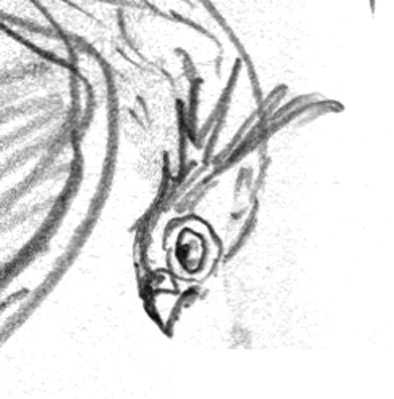
 

L sad 4

No.4. This is my preferred facial expression. It says best what I think Leonard is feeling.
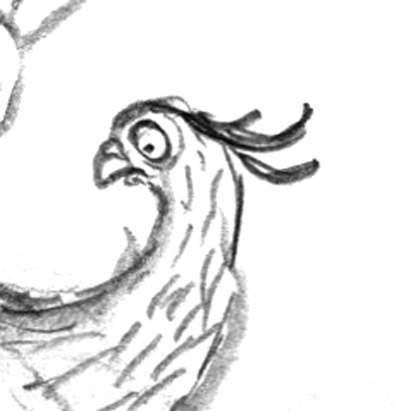
L sad 1.jpg

No. 1. The expression seems a mix between extreme mortification and horror, with a bit of disgust thrown in. The up-curving neck shows too much energy. I want Leonard to look a little defeated. 
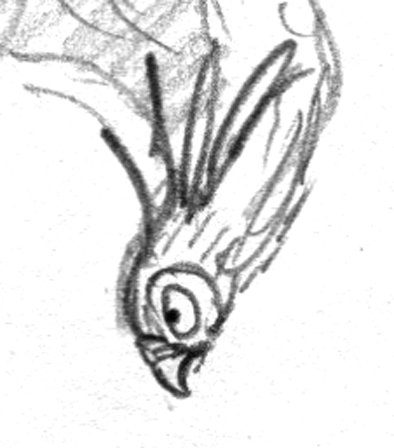
L sad 6.jpg

No. 6 Although I like the body posture with raised wings, the face here is not quite as good as  that of No.4. The head tilt is less submissive, more head-butt. The crest is more raised, the eye less miserable.

L sad 2

No.2. Utter dejection with 1920s silent movie era eye makeup! Leonard is not even looking back, just downwards. I think I’d rather he looks wistfully backwards as it indicates a suppressed longing to join in. I don’t want our boy to be completely bereft of spirit. Poor lad.

Sometimes a thing like this can be positively excruciating if you can’t get it right. But today I enjoyed it. Leonard is  very accommodating.

In Leonard’s case, I have the eye to work with and also the caruncle (a patch of coloured skin) around his eye, which acts as an eyebrow or an underscore for the expression in his eye. And living with a flock of chickens has taught me what a sick or miserable chicken looks like; the hunch, the fluffed up feathers, and sometimes the dropped wings.
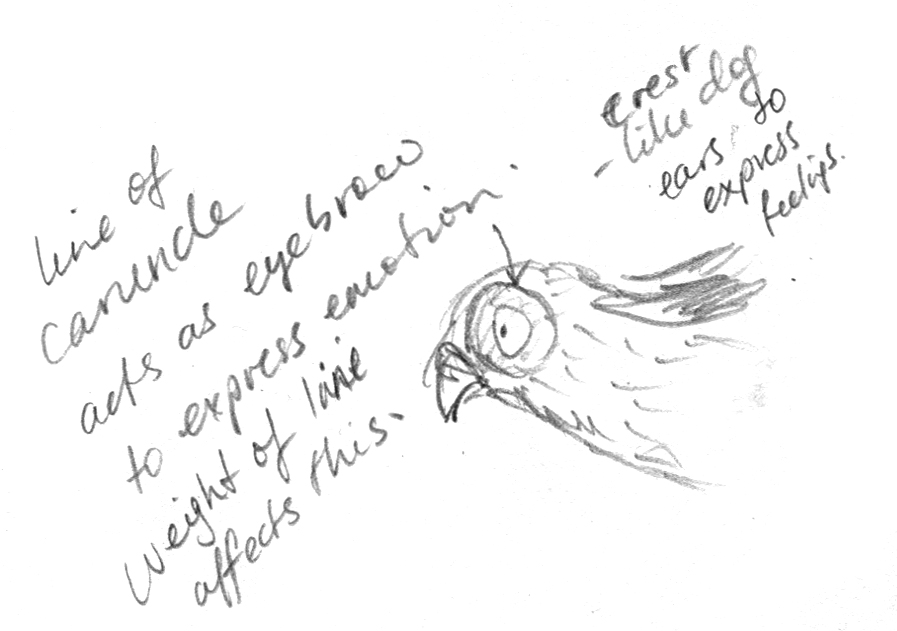
L dejected.jpg

But with Leonard’s crest I depart from the nature of birds. A fluffed up crest in the real world might indicate bird misery, but I’m using Leonard’s crest more in the way of ears like a dog, that drop when miserable, raise when interest is sparked. That is probably a language more readily identifiable to children, since more have dogs than chickens… in Australia at least.

So that covers the face. What about the body?

dejected posture.jpg

He’s retreating, so he’s best drawn partly from behind. The fluffed up hunched shoulders, I mentioned earlier. He should look clumsy, so I experimented with leg postures. He has just alighted so I need to suggest the flight just finished. And he’s walking away and downwards, so I have to suggest the forward downwards movement as well.

One challenge is the wings. Raised wings (6) could suggest a certain lifting of spirits. Spread wings look nicely clumsy (5) but tend to get in the way of the main subject (his lowered face). Lowered wings (2, 4) may be best for misery but are not so good for movement and flight. (In 2 he looks positively beaten. It’s a bit much.)

wings raised.jpg

Today as I was working on this, I once again remembered my fabulous school art teacher Cecily Osborn. I remember her explaining how artists can seek to depict movement in a motionless work of art. She used the ancient Greek sculpture of a discus thrower Discobolus by Myron as an example. The sculpture doesn’t depict any real life movement employed by an athlete whilst throwing a discus, but instead attempts to creatively suggest the movement that came before as well as hinting at the movement to follow the instant in time depicted by the sculpture. The sculptor borrows our imagination to evoke a movement that he can’t create in reality.

roman bronze reduction discus_thrower_Myron

A Roman bronze reduction of Myron’s discus thrower. The original artwork was made around 450BC.

“The potential energy expressed in this sculpture’s tightly wound pose, expressing the moment of stasis just before the release, is an example of the advancement of Classical sculpture from Archaic.” (says Wikipedia)

I’m very serious today, aren’t I? Do you think I am overthinking this?

I don’t think so. These thoughts take longer to describe than they do to think. All this and more goes through an illustrator’s head as he or she is drawing. And a lot of it is subconscious too. But it’s part of what makes the pictures work, it’s part of observing our world, and how the experiences of life feed into an artist’s work. I love that about my job.

But here are a couple of over-excited woodpeckers, because I wasn’t just drawing misery today.

Cheerio!

woodpecker black and white judywatsonartwoodpecker judywatsonart

Hello studio, hello birds, hello autumn.

It’s the second week of the school holidays and I’m back in the studio today after a busy week with the family. The boys are visiting with their grandparents in the country all this week. And I have no work to show you yet, so I thought I’d just say hi.

I really love the autumn in Victoria. The light is soft and warm with honey tones like a dessert wine. (yum.) It’s the best time of year for closing your eyes and lying in the sun,

Hugo shaking apples down.JPG

for shaking apples from the apple tree,

last water fight of the season.JPG

or for having the Last Great Water Fight of the season.


But in the midst of this mellow finale, the wild birds have been rowdy today for some reason, as they were back in the spring when they were fighting for nesting sites and mates and eating each other’s babies!

This afternoon I saw a kookaburra nearly stun itself by attacking its reflection in our lounge room window, as a grey butcherbird watched closely, waiting for an opportunity. While the kookaburra sat on a branch recovering its composure, the butcherbird (3 flights up) dived down and audibly clouted it on the top of the head. Is that adding insult to injury, or injury to injury? The kookaburra raised its head feathers in lieu of a comb or a finger and looked outraged and rumpled but didn’t pursue.

Our chicken girls weren’t rowdy though. In fact, they were a little alarmed by the swooping and noises in the trees around them when I let them out this afternoon.

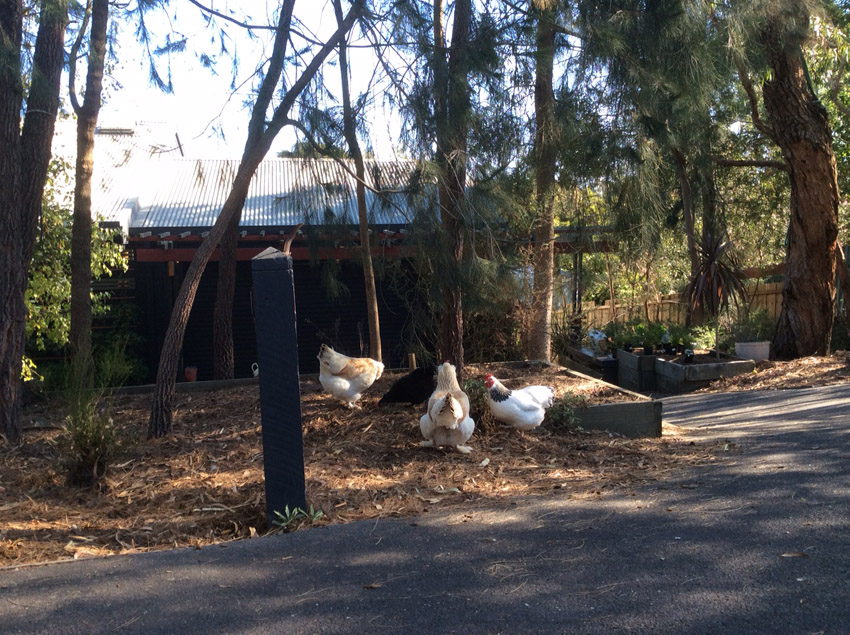
chicken conference in driveway.jpg

A chicken conference under the sheokes.

Takara spots a kookaburra.jpg

Takara demonstrates her funky chicken dance as three kookaburras overhead cause some concern with their noisy display. 

fluff balls eating south african food.jpg

Our two Salmon Faverolles, Takara and Cressida Cowell eating peanuts in the driveway. Takara (on the left) has started laying and hence the big, red comb. Cressida is a late bloomer and a big, fat baby who galumphs about tripping over her ugg boots. She is by far our largest and heaviest chicken and at the bottom of the pecking order. It’s amusing to watch tiny Storm scold her whilst barely reaching up to Cressida’s fluffy chin at full stretch. 


Meanwhile, back in the studio, for want of new artwork to show you today, here are some of the musicians that didn’t make it through the auditions recently.

They don’t mind. They have a regular gig down at The Swamp on Thursday nights.

swing band.jpg

Here are a pair of cockatoos do-si-doing. They are going to try to squeeze into a spread for Leonard Doesn’t Dance tomorrow.

20-21 dancers 3.jpeg

My drawing board now that the sun has gone down,

drawing board.jpg

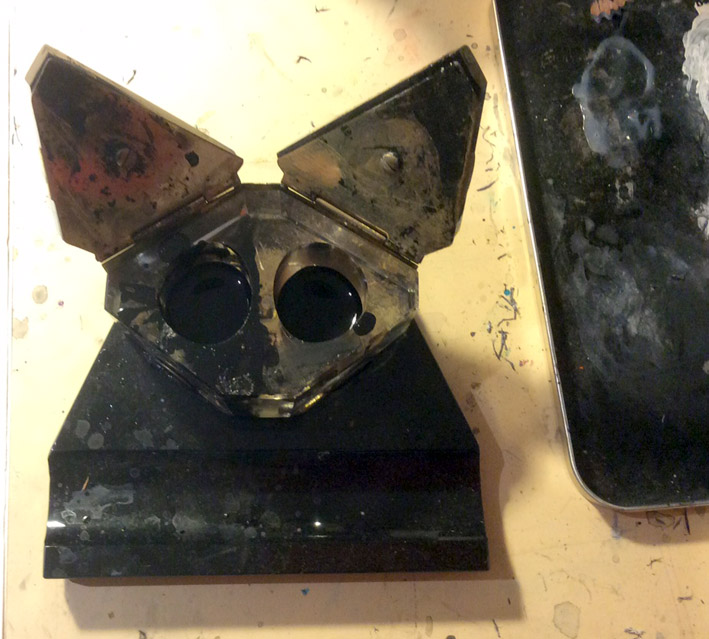
My black Cornish Rex inkwell,

Cornish Rex ink well.jpg

and last of all, something that isn’t here yet. The Squirrel. A wood fired stove that will soon be warming my studio. Woohoo! 

morso-1430.jpg


Bird Immersion (2)

This is another quickie post. It’s all terribly busy around here.

Even the birds are looking a bit concerned.

call duck

I’ve often seen ‘Call Ducks’ advertised when I have been browsing the chickens-for-sale ads (as some of us do). I feel this may be what they look like.


worried galah

And this galah barely knows which way to turn.

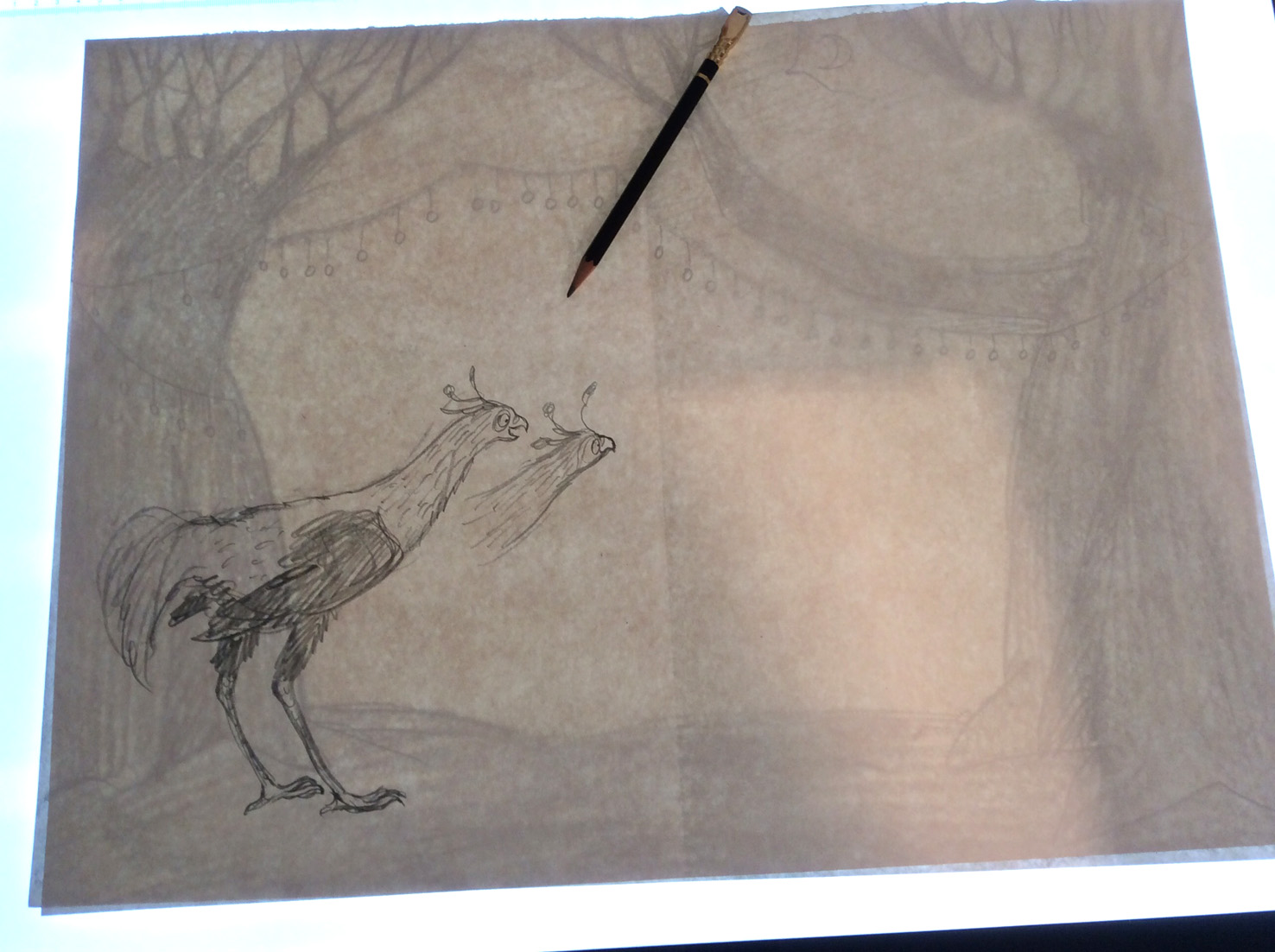
light box in action

I’m still excited about my new light box. It’s much bigger than the trusty old one. It gets brighter or dimmer if you hold your finger on the power button! Sometimes I do that just for fun.

You may be able to see that one spread looks rather a lot like the (empty) stage of a theatre. It’s not a stage, but I quite like that it looks like one. And I like that I can sketch the characters freely on a separate sheet of paper over the top of the scene. I suppose this is what animators used to do all the time.

20-21 muso initial sketches

These are my first drumming bird sketches. It’s been interesting to work out how the bird might play the instrument and how much to simplify or modify the instruments from those in the real world. I liked the bounce in the woodpecker trio at top left but I came up with a much better drawing later. The first one I drew here was the duck and that drum looks most unstable. I’m not sure it’s even three dimensional!

I worked out a great plan (my 25th) for the cover of Leonard Doesn’t Dance in the shower the other day. I often draw Leonard covers on the shower screen. It is an important part of my process and one of the more literal interpretations of bird immersion. Luckily I have imprinted the idea almost perfectly on my brain, because when I went back to the bathroom to photograph the cover design, it had melted away….

That reminds me, I need to buy another back-up hard drive for my computer.

And lastly, for those of you who are interested in bird immersion in general, (you may be the kind who browse the chickens-for-sale ads) did you know that some chickens can swim? Go here to see the most gorgeous Buff Orpingtons in a swimming pool.

It should be added at this point, that we had to rescue Stella from the fish pond a few weeks ago as she fell in and did not seem to have the required flotation skills.

(Why does ‘floatation’ look wrong?)


Bird Immersion

Sorry I haven’t been around in Blog Land.

20-21 Leonard with 2 heads


Happily, this is mainly because I’ve been so busy drawing my roughs for Leonard, (and turning 50, and looking after an extra child because we have an overseas student staying with us at the moment).

I have to say, despite the fact that I’m multi-tasking like crazy (bad) Leonard is really fun (good!).

I can’t show you very much (bad). Many of the roughs describe the finished image. And this book, true to Frances Watts’ Style, will be brimming with humour (good!). So by showing you the full page roughs, I would be giving away all the gags (terribly, terribly bad).

But I can share with you bits and snippets and here-and-there touches.

chickens lightened.jpg

It’s interesting that the roughs have reverted to pencil, maybe my most natural medium. And this will pose its own challenges when it comes time to make the final art with broad paint strokes. The roughs began as large paintings, then switched to charcoal, and finally, to pencil.

singing

swingin Leonard

And something I’m excited about is my new light box! Wowsers! It’s so cool.

But I’m going to leave this and write more later.

I’m multi-tasking, remember?


Fish Feast Update

This greedy little pelican, a doodle drawn for feast week in the 52 Week Illustration Challenge back in 2014, just returned from being on holidays at a friend’s beautiful retreat in Warburton, Victoria. (You can find the retreat here if you’d like to book a stay.)

As a result partly of the sunlight and partly of the unorthodox materials used to produce the drawing (for more info go here!), I noticed that the fish parts and wave pattern had faded to rather a nice sepia colour.

faded Pelican

I probably should have left it that way. But it seemed to be calling to me like this…

Judy, Judy, colour me in! Pleeeease colour me in, I beg you!

[repeat and intersperse with pitiful whimpering]

Being a soft hearted thing, and fond of pelicans, I did as I was asked with the following result.

pelican feast colour pencil

I’m pretty sure I prefer the original grittiness and I’ve got a bit of a tummy ache from the chips I was eating at the same time.

But boy was it fun!